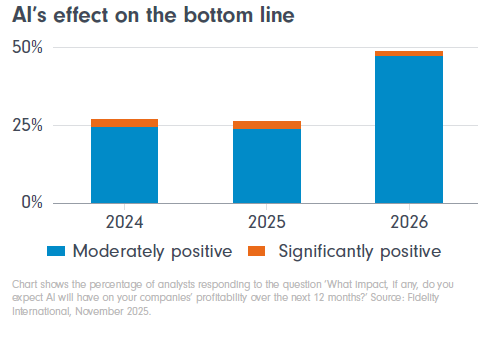
A new survey* from Fidelity International, encompassing the views of its global analysts, reveals that artificial intelligence (AI) is beginning to make a tangible impact on corporate profitability. Nearly half (49%) of Fidelity’s global team of research analysts now expect AI to positively influence company profitability in 2026, up from around a quarter (26%) the previous year.
A year ago, most Fidelity analysts expected that AI would take several years to deliver material returns for companies, particularly outside the technology sector. However, recent evidence gathered by Fidelity’s research team suggests that businesses are now translating investment in AI into measurable outcomes, from revenue generation to operational efficiency.
Punam Sharma, Head of Equity Research, Europe at Fidelity International, comments: “What we’re seeing now is a turning point. A year ago, AI felt like a distant opportunity, yet today, it’s starting to reshape business fundamentals. Companies are no longer experimenting with AI in theory; they’re deploying it to drive growth, productivity and innovation. What has changed is the urgency of adoption.”
Sectors set to benefit most in 2026
According to the survey, AI adoption is poised to deliver widespread benefits across industries in 2026, with Communication Services leading the charge. Healthcare and Financials follow closely, underscoring how AI is transforming both patient care and financial operations through data-driven insights and automation.
In the financial sector, Fidelity’s analysts point to institutions using AI to support sales and trading, improve customer experience, and detect fraud more effectively. Banks are also integrating AI tools that prompt advisors with product recommendations and investment ideas, enabling more personalised services.
Meanwhile, more traditional sectors like Real Estate and Consumer Staples show more modest prospects, indicating a slower pace of adoption where automation and data analytics have yet to make a broad impact.
Punam Sharma comments: “The findings illustrate a clear trend: AI’s influence is spreading rapidly, with technology-intensive and knowledge-driven industries expected to see the strongest performance lift as AI integration matures through 2026.”
Second order effect #1: Datacentres driving energy and commodity demand
As AI adoption accelerates, Fidelity’s analysts expect the technology to have knock-on effects beyond the companies that use it.
Punam Sharma explains: “AI is fuelling demand for the build out of datacentres and other infrastructure. These data centres are highly energy intensive, increasing the need for reliable power generation and key commodities such as copper.”
Second-order effect #2: Labour, productivity and the shape of future growth
Many companies are already generating higher revenues without increasing employee numbers, indicating that AI is starting to change the relationship between labour and productivity. While this raises questions about potential job displacement, it also highlights how AI can enhance output and support a reallocation of human capital to higher-value roles.
Punam Sharma adds: “While there will be disruption, history shows that technological progress can ultimately expand opportunity, provided companies and workers adapt quickly and ethically.”
What next for AI?
Despite strong optimism, Fidelity’s analysts caution that not all AI initiatives will deliver the expected return on investment. Heavy infrastructure spending could strain profitability if demand lags behind, and some business models remain untested at scale. Nonetheless, the pace of progress continues to impress, and AI-driven innovation is already reshaping competitive dynamics.
Punam Sharma concludes: “Will AI models deliver on all they promise? The truth is, it’s still too early to say. What’s undeniable, however, is the speed of their evolution, and the tangible advantages already being realised by organisations putting them to work in practical, real-world ways. Those who choose to stay on the sidelines risk being left behind.”
Important information
This material is for Investment Professionals only, and should not be relied upon by private investors.
Investment values (and income from investments) can go down as well as up, so you/the client may get back less than you/they invest.
Any investment views expressed may no longer be current.