- Smart farming
Smart farming refers to the idea of bringing big data to the world of agriculture, which has long been focused primarily on enhanced mechanisation.
Given the sheer variety of processes and stages involved in rearing animals and growing food, the range of technologies smart farming encapsulates is too wide to cover here. But for an idea of the scale of disruption we are looking at, one only needs to look at John Deere.
The company is essentially pivoting into becoming a tech platform with their Autonomous 8R Tractor which allows farmers to tend to their crops via an app. Six pairs of cameras on the tractor enable 360-degree obstacle detection and distance calculation. The tractor also continuously checks its position relative to a geofence, ensuring it is operating where it is supposed to, and is within less than an inch of accuracy.
Using the John Deere Operations Center Mobile (OCM), a farmer can configure the machine for autonomous operation. The OCM system provides access to live video, images, data and metrics, and allows a farmer to adjust vitals like speed and depth and can make adjustments to optimize performance as needed.
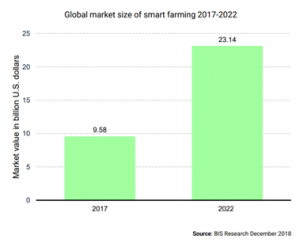
Again, this is just one example of smart farming in action. But when you consider how it can make large-scale agricultural problems like eutrophication a thing of the past, it quickly becomes clear that smart farming is a vital part of any sustainable food system. Indeed, it’s no coincidence that the size of the market is on track to hit $23.1 billion in 2022 from just $9.6 billion in 2017.
- Vertical farming
Vertical farming is the practice of growing plants indoors in many stacked layers. And because this enables conditions to be fully controlled, it offers a wide range of advantages over traditional farming.
From being able to produce crops reliably all year round regardless of the weather, to minimising the use of space, water, energy, and pesticides, enabling farms to be established even in the most urban environment.
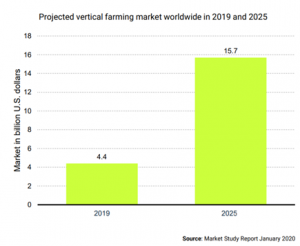
Vertical farming has already become a $4.4 billion global industry.
But the most exciting thing here is that this space is not even close to reaching its full potential.
Indeed, as technological advantages enable a wider range of crops to be produced (its currently limited largely to tomatoes, herbs, and berries), and as urban living becomes even more popular, vertical farming stands to account for an increasing portion of the food we consume in total.
Indeed, forecasts already put the value of the space at an impressive $15.7 billion within just three years.