Daniela Sabin Hathorn, senior market analyst at Capital.com, has shared her assessment of the S&P 500 market.
The question is whether this is another dip in the uptrend in US stocks or the start of a reversal. A closer look at the daily chart for the S&P 500 and reveals a somewhat chaotic picture. The Relative Strength Index (RSI) has fallen into selling territory, and the key moving averages are no longer consistently positioned below current prices. However, recent lows have held firm, finding support at the 100-day Simple Moving Averages (SMAs).
For the bearish trend to solidify, the index would need to fall below the level where the bullish uptrend began to plateau—around 5,800 for the S&P 500.
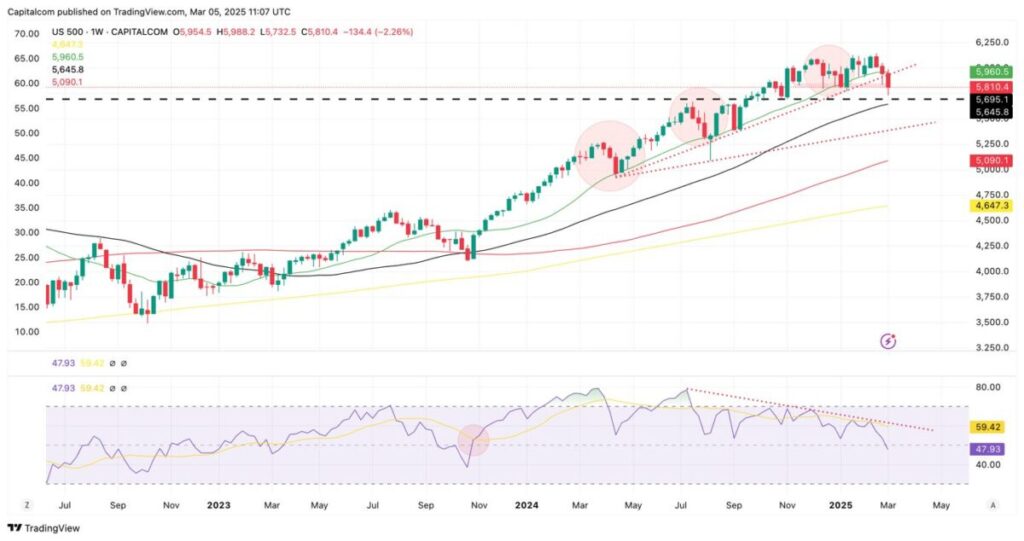
When zooming out to the weekly charts, the current pullback appears less threatening. Since the uptrend commenced in October 2023, there have been three previous corrections. Each time, the 20-week SMA provided robust support and allowed the market to reset before attracting fresh buyers. This historical pattern suggests that the current downturn may be a temporary pause rather than the start of a reversal.
05/03/2025 – Update
The 100-day Simple Moving Average (SMA) failed to contain the latest wave of selling, causing the S&P 500 to dip below its critical 5,800 support level on Monday. Markets were rattled by a panic-driven selloff following the implementation of President Trump’s tariffs on Mexico and Canada. Although the initial reaction was severe, momentum shifted late in the session, allowing buyers to recover some ground and push the index back into its key support area. Still, the situation underscores the warning signs identified in last week’s analysis, including a notable bearish divergence on the weekly chart.
On the daily timeframe, the Relative Strength Index (RSI) has sunk further into selling territory. More tellingly, the RSI on the weekly chart has dropped below 50 for the first time since the current bullish rally began in October 2023. Over the coming weeks, the critical level to watch is 5,695, which marks the start of the previous pullback in late 2024. A decisive break below this point could signal a longer-term correction, paving the way for further weakness in U.S. equities.
It is important to note that any potential reversal may not follow a straight downward path. Certain sectors could still benefit from solid underlying fundamentals. While the Federal Reserve’s restrictive monetary policy can limit the upside for stocks, it also reflects an economy resilient enough to keep investors confident. The primary threats to the bullish outlook include uncertainties surrounding Trump’s trade and tariff strategies, as well as concerns over rising debt levels—an issue likely to intensify if the proposed tax cuts move forward.
S&P 500 weekly chart
Past performance is not a reliable indicator of future results.