Net retail outflows reached £2.3 billion in 2025, on par with 2024, according to data released by the Investment Association today.
The continued yearly redemptions reflect significant uncertainty, initially due to a shifting geopolitical climate over trade and defence, before pre-Budget speculation and concerns around the concentration of major US equity markets impacted behaviour in the latter half of the year – all of which drove a more defensive investor stance.
Throughout the year, markets showed resilience with robust performance leading to a 9% annual growth in funds under management (totalling £1.62 trillion, increasing from £1.49 trillion at the end of 2024). While this did not translate to an annual inflow, some asset classes, including money market, mixed asset funds and fixed income, saw consistent flows throughout 2025 as investors adopted a risk-off sentiment.
The first quarter recorded £2.3 billion in redemptions, followed by £4.7 billion inflows in Q2 – the only quarter in 2025 recording total net inflows. Monthly inflows peaked at £3.3 billion in May, boosted by ISA season and investors ‘buying the dip’ in the wake of Trump’s ‘Liberation Day’ and tariff policy.
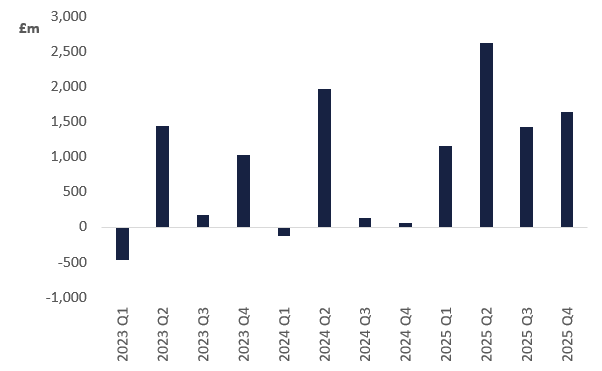
The second quarter also saw money market fund inflows peak at £2.6 billion. The popularity of the asset class reflects a ‘wait and see’ response to geopolitical tensions, as investors and professional advisers favoured cash-like investments for their flexibility and liquidity. Indeed, Short-Term Money Market funds were the best-selling sector for 2025, leading sales in every quarter after the first, when North American equity funds briefly took the top spot.
Outflows in the third (£2.7 billion) and fourth (£2.0 billion) quarters reflected both the growing uncertainty over an equity market correction and persistent speculation over tax changes in the two months up to the Budget.
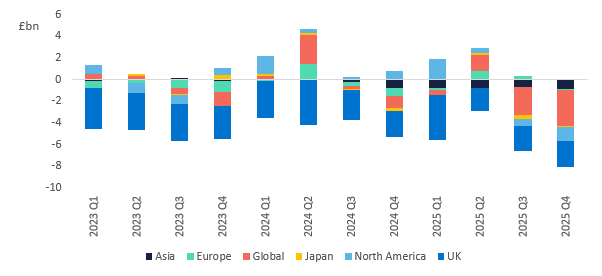
Equity funds saw -£16.8 billion flow out over 2025 due to many investors becoming increasingly cautious about high exposure to large cap US tech stocks as speculation grew that an AI bubble could cause a correction in their valuation. North American equities saw particular redemptions in H2 (£2.0 billion) while Global equity funds, many of which have significant exposure to the largest US tech companies, saw -£4.8 billion flow out across the year. This sentiment mildly benefited European equity funds, which reached inflows of £761 million as investors looked to diversify. UK equity outflows calmed somewhat, experiencing the best result since 2021. Although, flows remained negative for the region at £11.1 billion.
Outflows reached their peak at £4.6 billion in October amidst speculation about potential changes to pensions in the Budget, a pattern repeated from 2024, as investors took their tax-free lump sums. While uncertainty over tax changes has negatively affected investor confidence for two successive years, the final two months of 2025 ended on a firmer footing, supported by inflows in November (£606 million) and a stronger December (£2.0 billion).
Key findings for 2025
- Money market and mixed asset funds emerged as the year’s bestselling asset classes, attracting inflows of £6.9 billion and £4.5 billion respectively. Investors prioritised diversification and stability amid heightened geopolitical and policy uncertainty. Short-Term Money Market funds were the best-selling sector in 2025 (£6.1 billion).
- Equity funds recorded £16.8 billion of outflows in 2025, higher than 2024 but below the record withdrawals of £22.4 billion in 2023. North America and Global suffered significant redemptions in the face of concerns about allocating more to strategies with exposure to large cap technology stocks, with global equities seeing £4.8 billion of outflows over the course of 2025.
- Fixed income funds posted £1.1 billion of inflows over the year, down from £3.6 billion in 2024. Bond funds saw inflows through the second half of 2025 as investors adopted a more risk off sentiment and diversified away from equities. Mixed Bond funds were the most popular with £1.2 billion in net inflows over the second half of the year.
- Tracker funds attracted £12.8 billion of inflows in 2025, down from a record £27.6 billion in 2024.
- Actively managed funds saw outflows ease significantly to £15.1 billion, compared with £29.9 billion in 2024.
Quarterly equity net retail sales by region, 2023 – 2025
Money Market Funds top 2025 inflows
The combination of market uncertainty and fluctuating investor confidence through the year benefited inflows to money market funds, which was the highest selling asset class of 2025 at £6.9 billion. As investors waited to see how markets would move following the introduction of tariffs, money market funds were a useful short-term, liquid option for many investors managing their allocation strategies. However, through 2025 we have seen inflows for 10 of the 12 months of the year as sustained uncertainty has driven increasing use of defensive positions.
Quarterly net retail sales to money market funds, 2023 – 2025
Miranda Seath, Director, Market Insight & Fund Sectors at the Investment Association, said: “2025 saw a small outflow from UK retail funds. Through extended periods of geopolitical and market uncertainty, investors were cautious. In 2025, investors rotated away from US and global equity strategies and into diversified, lower‑risk asset classes, such as money market, mixed asset and mixed bond funds. We end the year on a positive note, seeing £2.0 billion flow in through December across fixed income and mixed asset as equity outflows softened substantially.
“Looking forward, we expect 2026 to see retail fund flows to continue to build back. Demand for diversified, lower risk allocations looks set to continue in a climate of persisting geopolitical uncertainty, evolving monetary policy in the UK and the US and ongoing concerns around high US equity valuations. At the same time, investing is a long-term game. The Leeds Reforms provide a once in a generation framework to bring more UK adults into investing: the stage is set to drive an increase in retail investment across the UK.”