The European Commission’s Savings and Investment Union (SIU) initiative has sparked a long-overdue conversation about the need to mobilise private savings and channel them to European companies, particularly given that European households have around €10 trillion deposited in low-yield bank accounts.
This not only deprives firms from much-needed new sources of financing but also harms households on the long-term as inflation eats away savings. Indeed, EFAMA demonstrated that a hypothetical investment of €10,000 in 2014 split between equity and bond UCITS would have grown to €12,494 over ten years (inflation-adjusted), a 25% gain, while the same amount sitting in a bank would have shrunk to €8,004, a 20% loss.
But what’s more, when Europeans do invest, much of that capital heads straight to the US, where deeper capital markets lure Europe’s most promising companies, with roughly €300 billion of European savings flowing overseas to US markets every year. Europe’s own growth potential is then underfunded, and its capital stays on the sidelines.
Historically, the EU is known for having a lower risk appetite than the US which is coupled with less opportunities for financing growth in innovative new companies. A European Investment Bank study shows that ten years after launch, EU scale-ups raise 50% less capital than US peers, making it easy to understand why founders would be eager to take their innovations over the Atlantic.
So how can Europeans’ trillions in savings be used to boost the competitiveness of the EU economy and put European capital markets on equal footing with the US?
Public equity may not be the answer, but alternatives are
When investors think about “investing in Europe”, many imagine buying European stocks online; one click and then you own a slice of a company. But this investment does not go to the company, but rather to the pockets of whichever shareholder sold you those shares. No fresh capital reaches the company itself, and that’s exactly the problem with how many investors are trying to channel funds into Europe.
European companies really need capital directly in their pockets. That’s where alternatives come in, which offer access to higher returns, real-economy impact, and diversification beyond volatile public markets. Unlike public equities, alternatives inject fresh private capital straight into the businesses that need it most, funding innovation and growth.
Mario Draghi pointed out in his well-known report that Europe hasn’t created a single company valued over €100 billion in the last fifty years, while the US produced six €1 trillion giants in the same period. Now imagine if the €300 billion that flow to the US every year stayed in Europe, fuelling local scale-ups and startups through private equity, private credit, and venture capital. The continent could then disrupt industries, build new growth engines, and elevate its global competitiveness.
A new mindset to complement the SIU
The SIU is a crucial step toward mobilising private savings, but it won’t make an impact unless European investors change their investing behaviour. First and foremost, the shift requires a robust understanding of the alternative investment vehicles at investors’ disposal, particularly the private equity, venture capital, private credit, and infrastructure funds that are flourishing across the EU.
Clean energy investments illustrate how alternative capital can simultaneously strengthen the EU economy and advance its strategic priorities, and it doesn’t scale without infrastructure. Infrastructure funds are essential to financing wind farms, solar parks, battery storage, grids, and hydrogen networks, providing the long-term, patient capital these projects require. By financing renewables and low-carbon technologies, these investments reduce energy dependence, enhance industrial resilience, and lower long-term energy costs.
With the European Commission committing to deploy at least €1 trillion in sustainable investments between 2021 and 2030, the EU’s highest executive authority has signaled that clean energy is a strategic priority. That level of political and financial commitment creates powerful spillover effects. For alternative asset managers, it means a growing universe of investable projects, and for investors, it means access to long-term, policy-backed growth aligned with Europe’s competitiveness agenda.
Improving financial literacy is also a key step to unlocking alternatives for European investors. When investors understand how alternative funds put capital directly into companies while offering the potential for strong, long-term returns, they are more likely to participate. Clear guidance on the long-term and illiquid nature of these vehicles, paired with interactive resources, simulators, and real-world examples, transforms what can seem complex into a tangible, compelling opportunity.
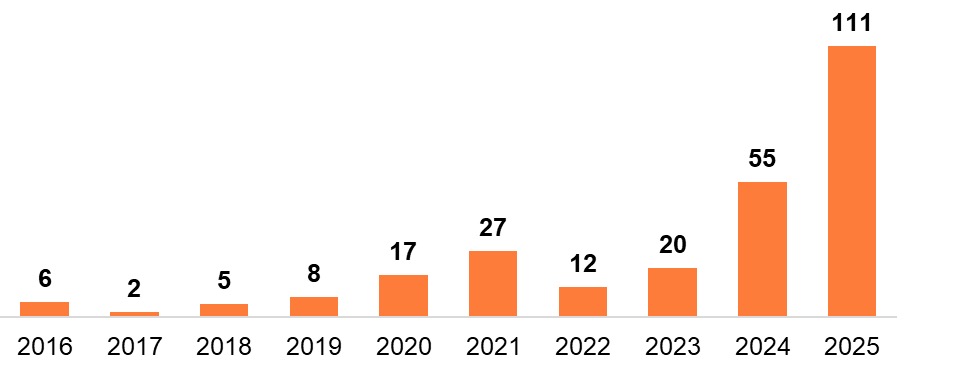
In this vein, European Long-Term Investment Funds (ELTIFs) – funds designed to channel retail investor capital into long-term, alternative investments – have seen exponential growth in recent years as seen in Figure 1 below, attracting record inflows as investors recognise their ability to finance infrastructure, scale-ups, and sustainable long-term projects across Europe. By familiarising investors with ELTIFs and other alternative structures, financial literacy efforts can channel private savings toward productive investments that strengthen European competitiveness.
Figure 1. Number of new ELTIFs issued each years since the introduction of the regime in 2015
Turning savings into Europe’s growth engine
Investing in alternative strategies is a win-win for both investors and European companies.
For companies, alternatives provide direct capital to finance innovation and expansion. This allows them to grow and compete globally, strengthening the continent’s economy. For retail investors, alternatives offer a way to put idle savings to work, rather than letting money sit in bank accounts where it slowly erodes due to inflation. By investing in real-economy assets, investors gain the potential for higher, long-term returns while supporting tangible growth in Europe.
Europe is sitting on a mountain of underutilised private savings, leading to many missed opportunities for growth and innovation. Alternative investments are the way to put that money to work, funding the engines of Europe’s next wave of competitiveness: scale-ups, infrastructure, and clean energy.
By embracing alternative investments and the fund structures that power them, European investors can turn idle wealth into innovation, jobs, and global influence, ensuring the continent doesn’t just follow the markets, but shapes them.
By René Paulussen, Alternatives Leader at PwC Luxembourg