José Torres, Senior Economist at Interactive Brokers, comments on the Best Month for Stocks Since 2020.
José discusses how stocks are poised to close out their best month since 2020, even as AI enthusiasm could be cooling off on the heels of four of the seven “Magnificents” reporting on Wednesday night.
Stocks Close Out Best Month Since 2020, Even as Mag7 Earnings Disappoint
Stocks are poised to close out their best month since 2020, even as AI enthusiasm could be cooling off on the heels of four of the seven “Magnificents” reporting on Thursday night, as a sharp pre-open rip was quickly dismissed, sending three of those names deep into the red. There’s certainly a long list of reasons for profit-taking at this juncture, especially in consideration of Wednesday’s hawkish pause from the Fed alongside a Middle East situation that’s at risk of escalation.
Indeed, Wednesday’s interest rate decision featured 4 dissenters, a level of formal disagreement not seen since 1992, as three officials favored removing the easing bias in the central bank’s statement in light of significant price pressure risks, while Governor Stephen Miran preferred a cut. Meanwhile, WTI crude remains well above $100 and even eclipsed $110 in the overnight session, as President Trump meets with his cabinet later today to potentially resume military attacks on Iran. But the drop from $110.93 to $105 has quelled the surge in yields that brought the 2-, 10- and 30-year maturities to highs of 3.95%, 4.44% and 5.01%, against the backdrop of a fixed-income complex that is increasingly believing that a hike is more likely than a reduction in 2026.
It’s precisely that alleviation in borrowing costs that has investors running to the cyclical Dow Jones and Russell 2000 benchmarks as tech gets battered due to too much capex and not enough cash flow to show for it in the present, generally speaking. The economic calendar was mostly positive with the exception of the inflation numbers, which were awful, as the PCE headline and core indices rose to 3.5% and 3.2% in March; however, GDP, unemployment claims and the employment cost index reflected ongoing shopping, robust business investment, subdued layoffs and accelerating paycheck gains.
In trading, most major equity sectors are appreciating, except for tech, communication services, energy and consumer discretionary. Elsewhere, the greenback is weakening, volatility protection instruments are seeing lighter premiums, commodities are advancing except for oil, cryptocurrencies are climbing, and prediction markets are catching bids.
GDP Rebounds as Capex Lifts the Headline
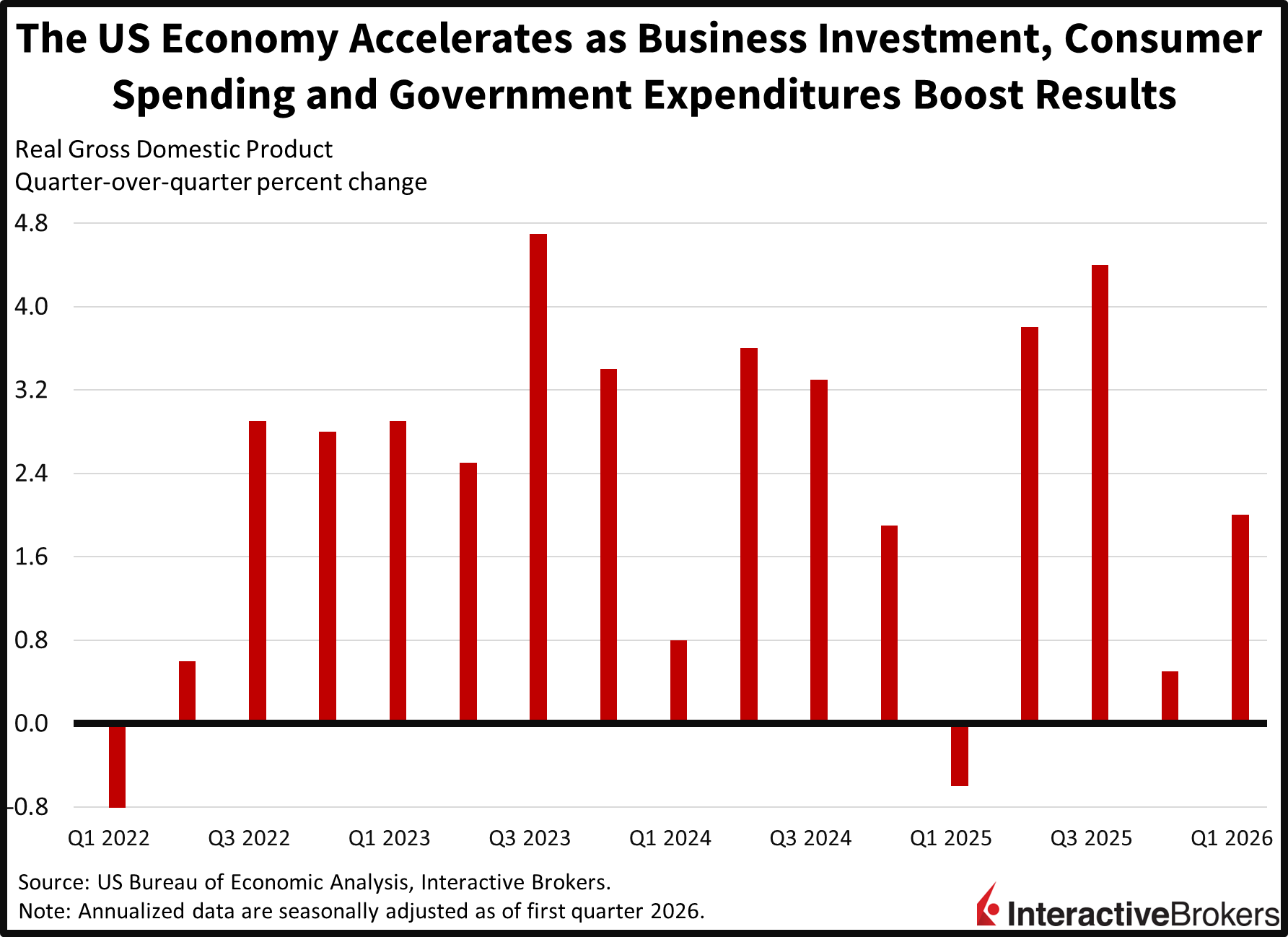
The US economy accelerated in the first quarter after the final period of last year was hampered by the longest government shutdown in history. The 2% growth rate in real Gross Domestic Product (GDP) accelerated from the 0.5% clip in the fourth quarter, though it missed the 2.3% median estimate. The contributors to the 2% expansion included 1.4% from business investment, 1.1% from consumer spending (most of which came from services rather than goods), 0.7% from public sector expenditures, and 0.4% from private inventories. Conversely, net exports subtracted 1.3%, as imports rose strongly and residential outlays were weighed down by 0.3%, as elevated mortgage rates continue to hurt construction activity and closings.
PCE Inflation Approaching Double The Fed’s Target
The March report on the Personal Consumption Expenditures (PCE) price index reflected fiercely accelerating cost pressures. The headline and core segments moved up by 0.3% and 0.7% month over month (m/m) and 3.2% and 3.5% year over year (y/y), exactly as expected. The results compare to 0.4% and 0.4%, and 3% and 2.8% from February. Last month, prices for nondurables, durable goods and services rose 2%, 1.4% and 0.3% m/m, while the energy segment advanced 11.6% during the period. Real consumer spending rose 0.2% m/m while incomes retreated 0.1%, serving to drop the personal savings rate to 3.6%, its lowest level since October 2022.
Paychecks Expand with Inflation
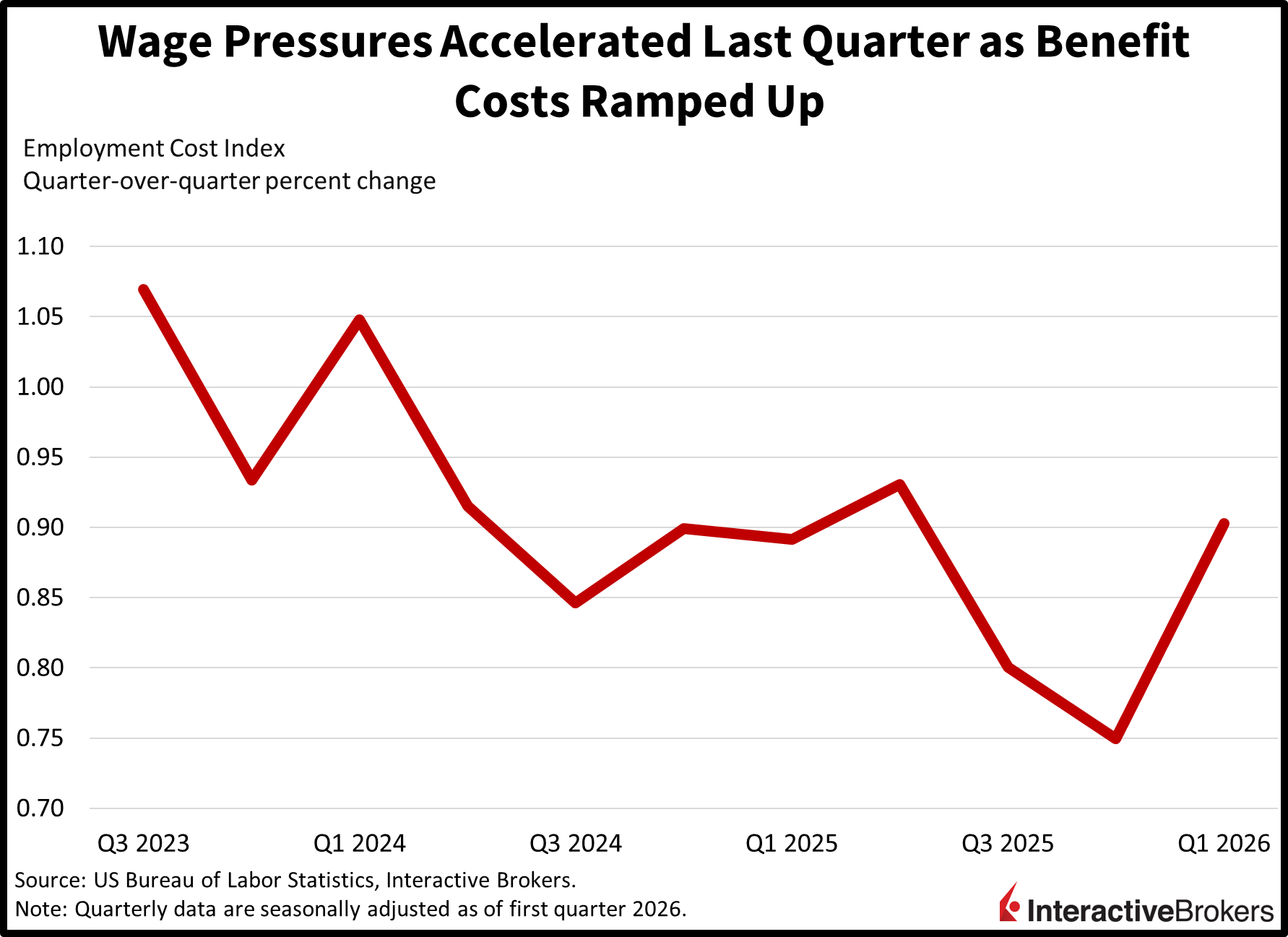
The employment cost index (ECI) expanded 0.9% quarter over quarter (q/q) in the January to March period, at a fast pace of increase over the past 3 quarters. The result came in ahead of the 0.8% median estimate and the 0.7% from the prior interval. Wages rose 0.8% while benefits increased 1.2% q/q, accelerating from 0.7% and 0.8% in the previous print. Furthermore, the public worker ECI rose 1% q/q, while private-sector employees saw a more modest 0.9% gain.
Initial Filings Fall To 57-Year Low
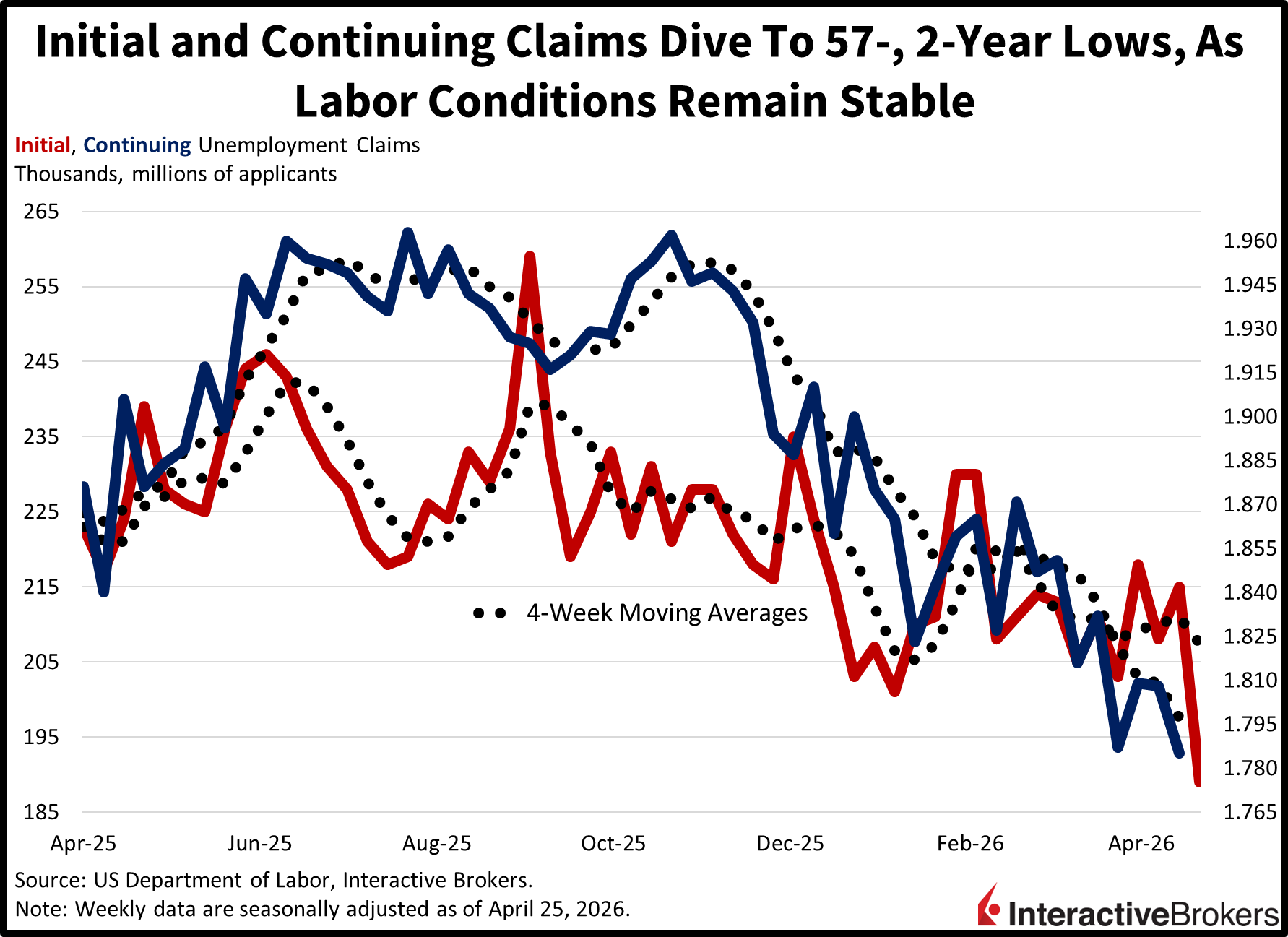
Unemployment claims also supported the view of healthy labor conditions, as initial filings fell to their lowest level since 1969, while continuing claims reached a 2-year low. The 189k and 1.785 million figures came in below the expected 215k and 1.820 million during the weeks ended April 25 and 18, as well as the 215k and 1.808 million from the prior prints. Four-week moving averages declined on both fronts to 207.5k and 1.797 million.
Sell In May and Go Away?
With the S&P 500 rallying 861 points from the March 30 low at 6,317 to an all-time high of 7,178 reached last Monday, some investors are wondering whether the old-school saying “sell in May and go away” applies on the final day of April. Meanwhile, it’s precisely the wall of worry that market bulls continue to climb that has paved the way for more upside. Indeed, certain analysts are asking if the war, the associated oil price shock, accelerating inflation and significantly higher interest rates are actually good for stocks, which stands in contrast to the traditional belief that economic fundamentals are important for risk assets.
Considering the relentless advance, bears have been starved, looking for the smallest of pullbacks, as animal spirits and AI enthusiasm have sparked a party on Wall Street even though macroeconomic risks are severe. What’s especially shocking is that Thursday’s lift is being carried by the cyclically oriented, rate-sensitive aspects of the equity space, and adds further evidence that the bulls seem to have an infinite amount of levers to pull. $100 oil used to be a headwind, but a pullback from $110 to $105 seems to be a tailwind in today’s trading.
International Roundup
The central banks of Europe and the United Kingdom decided to keep their rates on hold, but officials are highly attentive to accelerating cost pressures. Investors have pared back their 2026 hike odds; however, policymakers are worried that tightening their stance could drive the continent into recession. The views from both institutions served to quell global borrowing costs after the Fed meeting yesterday lifted them.