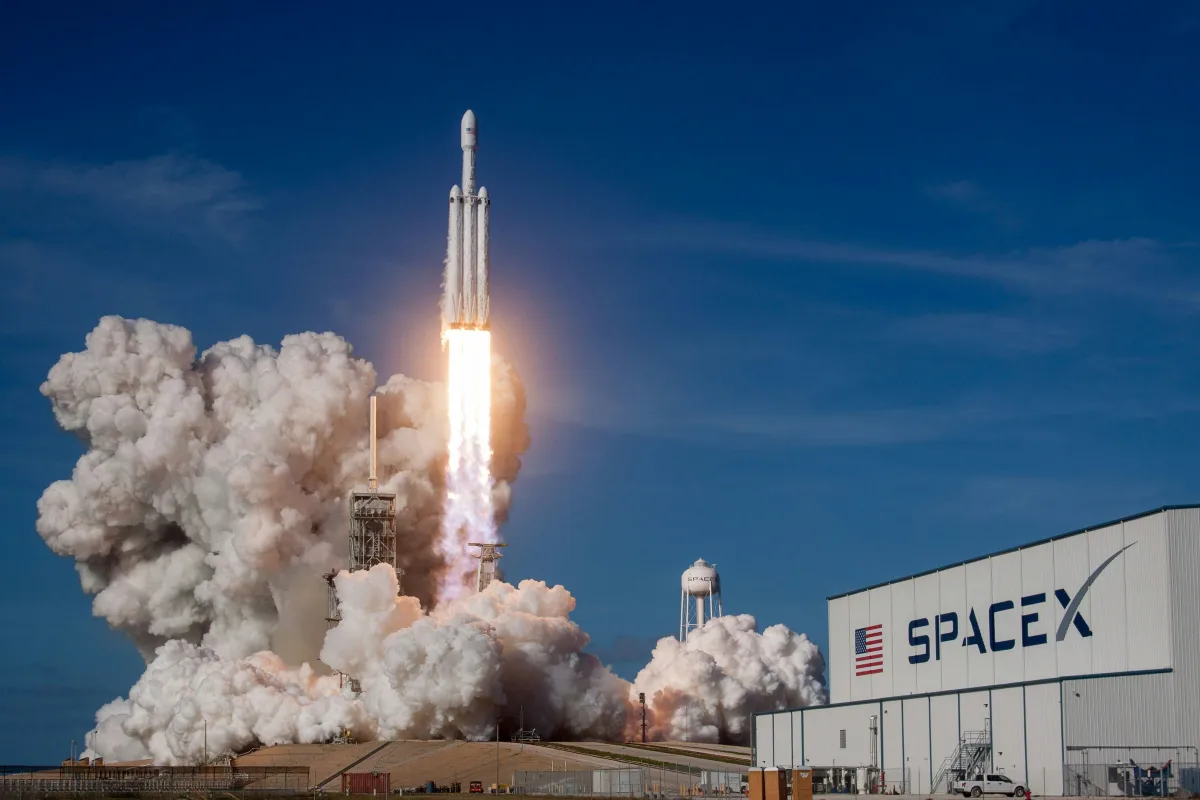
In what looks set to be one of the most hotly anticipated IPOs in years, SpaceX is set to blast off on 12th June as it looks to raise up to $75bn from investors at $135 a share, which would value the company at an eye-popping $1.75trn. Michael Hewson, Senior Market Analyst at iForex, comments.
This eye watering valuation looks set to see the business included in the Nasdaq with many questioning how anyone can justify such a stratospheric valuation at this level of fixed price, even before the book building process has started.
In doing this SpaceX runs the risk that some investors might baulk at the price tag, raising the risk it could come up short, as the investor road show gets underway.
On any normal metric the numbers defy belief given that last year SpaceX lost $4.9bn on the back of total revenues of $18.7bn.
While the increase in revenues of 33% from 2024 was welcome, most of the improvement came from its Starlink service, which contributed about $11.4bn.
On the basis of last year’s revenues of $18.7bn, a $1.7trn valuation would equate to 92 times sales, which for a business that can currently be described as either an aerospace or telecoms business is stratospherically high.
Having said that, last week Anthropic, which makes the “Claude” chatbot, saw its valuation surge to $965bn after securing $65bn in new investment for its AI capex, as it looks to set out its own timetable for its IPO, with OpenAI likely to follow suit.
With an annual revenue run rate at around 20 times earnings for Anthropic, that puts it close to Nvidia, which has a market cap of $5.3trn on a revenue run rate of about $250bn, but well below the multiple that SpaceX is looking to achieve.
So how can SpaceX justify such a price tag?
When looking at the underlying businesses it can’t.
With Starlink providing the bulk of the annual revenue, the rest is made up from its Space division which contributed just over $4bn, helped by the reusability of its Falcon 9 rockets, while its AI division, which is tied to xAI and X, delivered about $3.2bn.
As far as its Q1 26 numbers are concerned revenues were up 15% on the same period last year at $4.7bn, however losses also surged, rising sharply to $4.27bn in the quarter, fuelled by surging capex expenditure in the AI segment, which includes X.
This is the drain down which most of the money is going, with $6.4bn of operating losses last year alone.
The Starlink business helped to offset a good proportion of that with operating profits of $4.4bn, with the satellite and mobile business helping to do the heavy lifting when it comes to generating profits.
The Space division, while generating $4bn in revenue, still posted an operating loss of $619m, due to R&D spend on Starship where development on its V3 launch vehicle will help bring forward the time where it is able to put data centres in space.
While, according to its S-1 filing, SpaceX sees an addressable market of over $28trn, the valuation of almost all of this market comes in outside of its current competencies or businesses, and is based on the success of technologies that haven’t been perfected yet.
Broadband and mobile are estimated to have a combined $1.6trn addressable market, with AI infrastructure adding another $2.4trn, with the rest of the business and enterprise applications estimated to fill the remaining gap.
This makes it a highly ambitious goal given that all of its future growth will have to come as a result of future capex spending outside of its current markets, as it looks to deliver the ability to put data centres in space, as well as launching missions to the Moon.
Given this comparison, this SpaceX premium will be dependent on the business delivering on $25.45bn in contractual commitments for 2026 and 2027, as well as its ability to put data centres in orbit by 2028, using the power of solar energy to keep them running.
That would be a huge ask for a business with the ability to deliver on its ambitions here and now, let alone one where the technologies aren’t yet available, and/or are still being developed and tested.
In what is becoming an increasingly crowded field where space technology is concerned with people like Jeff Bezos also looking to develop solutions, that is likely to come across as quite a tall order in terms of the valuation, and as we saw last week comes fraught with risk after a test launch ended in a fireball on the launch pad.
As Musk tweeted at the time “Most unfortunate, rockets are hard. “
Thus, as we look ahead to the upcoming SpaceX IPO, any investor will be basically betting on the success or otherwise, of not only its Starship launch program, but also Elon Musk’s ability to deliver on the orbital data centre part of the business, as a stepping stone to the Moon and Mars.
All that aside, betting against Elon Musk in the past hasn’t exactly proved to be a successful endeavour, and this could well go the same way.
Let’s all strap in, it could be quite the ride.