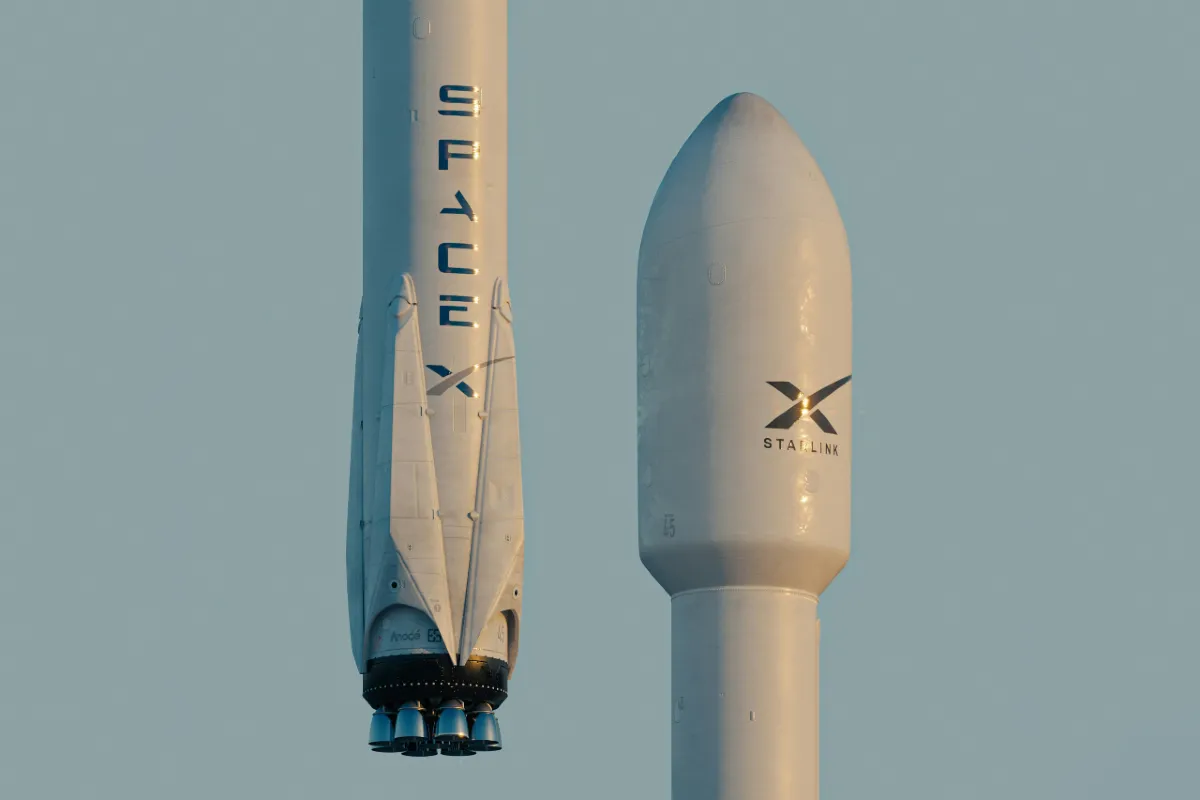
SpaceX’s IPO is more than a high-profile market event. It is a defining moment for investors in the space economy. Elvira Kuramshina, Associate Director, Quantitative Research at WisdomTree, weighs in on SpaceX.
For years, investors have watched SpaceX hit one milestone after another, but without an easy way to gain exposure through public markets. SpaceX’s listing changes that by bringing the category-defining leader of the space economy directly into the investable universe.
The case for SpaceX
Through reusable launch systems, the company has helped turn access to orbit from an infrequent, government-led activity into a more commercial, scalable, and increasingly routine capability. This shift is reflected in its operational dominance: SpaceX completed 165 orbital launches in 2025, accounting for more than 52% of all global launches, while deploying approximately 85% of all satellites and delivering 2.23 million kilograms of spacecraft mass out of a global total of 2.7 million kilograms.
SpaceX says Starship is designed as a fully reusable transportation system capable of carrying more than 100 metric tonnes to orbit in reusable configuration, while Starlink describes itself as the world’s most advanced low-Earth-orbit satellite constellation, with around 10,000 satellites. Combined with this scale, these capabilities give SpaceX a level of operational reach and ecosystem influence that is hard for any dedicated space strategy to ignore.
SpaceX is also the key Space player since it sits across several of the verticals shaping the space economy. It is not only a launch company, but also a satellite operator, a communications infrastructure provider, a key NASA partner in lunar exploration, and the company most closely associated with the long-term ambition of making human activity beyond Earth economically viable. In other words, SpaceX is not simply participating in the space economy; it is helping define its direction.
By making access to space cheaper, more frequent, and more scalable, SpaceX is helping unlock a much broader commercial opportunity across satellite connectivity, geospatial intelligence, defence space, in-orbit servicing, and a range of emerging applications, including in-space manufacturing, space-based data centres, lunar infrastructure, and space mining. For investors, a key question is what other markets is SpaceX helping unlock, and how best to capture the long-term growth potential of the commercialisation of space, with SpaceX as its defining force.
Exploring the universe beyond SpaceX
If SpaceX defines the direction of the space economy, the next question is who is building alongside it. The real significance of SpaceX’s success is not only what it has built, but what it has made possible. By lowering the cost of access to orbit and increasing launch cadence, SpaceX is enabling a wider ecosystem of companies to develop new technologies, services, and space-driven business models.
The evolution of the space economy is not a single-company story. A growing number of companies are focusing on different layers of the space ecosystem, from launch, in-space infrastructure and lunar exploration to connectivity, geospatial intelligence, space-based sensing and space-based missile defence architectures, and other emerging space technologies.
A number of emerging and established players are already contributing to this next phase of growth. Rocket Lab is helping expand launch capacity and in-space services, positioning itself as a vertically integrated provider of launch, satellite components, and mission solutions. Intuitive Machines is supporting the return to the Moon through lunar landers and infrastructure, contributing to the development of a future cislunar economy. Redwire is focused on space infrastructure and in-orbit manufacturing technologies, including advanced materials and production capabilities enabled by microgravity.
At the same time, companies such as AST SpaceMobile are pushing the boundaries of satellite-enabled connectivity, aiming to deliver direct-to-device broadband from space, while MDA Space plays a key role in satellite systems, robotics, and geospatial intelligence, supporting both commercial and government missions. Together, these companies illustrate how the space economy is evolving into a multi-layered ecosystem, spanning launch, infrastructure, connectivity, data, robotics, and emerging applications.
For investors, this highlights an important point: while SpaceX may be the key catalyst, the growth of the space economy will be driven by a much broader set of participants. The opportunity therefore lies not only in owning the leader, but also in capturing exposure to the companies building the infrastructure, services, and applications that will define the next phase of the space economy.
Disclaimer
This material is prepared by WisdomTree and its affiliates and is not intended to be relied upon as a forecast, research or investment advice, and is not a recommendation, offer or solicitation to buy or sell any securities or to adopt any investment strategy. The opinions expressed are as of the date of production and may change as subsequent conditions vary. The information and opinions contained in this material are derived from proprietary and non-proprietary sources. As such, no warranty of accuracy or reliability is given and no responsibility arising in any other way for errors and omissions (including responsibility to any person by reason of negligence) is accepted by WisdomTree, nor any affiliate, nor any of their officers, employees or agents. Reliance upon information in this material is at the sole discretion of the reader. Past performance is not a reliable indicator of future performance.