![[uns] cybersecurity](https://wealthdfm.com/wp-content/uploads/2025/08/mike-hindle-YSgZGl_a_3Q-unsplash.webp)
Lorem ipsum dolor sit amet, consectetur adipiscing elit, sed do eiusmod tempor incididunt ut labore et dolore magna aliqua. Ut enim ad minim veniam, quis nostrud exercitation ullamco laboris nisi ut aliquip ex ea commodo consequat.
AI-enabled cyberattacks are strengthening the long-term growth case for cybersecurity companies, according to James Thomson, manager of the Rathbone Global Opportunities Fund, who says CrowdStrike is well placed to benefit as businesses increase security spending and consolidate fragmented technology stacks.
Thomson said: “Earlier this year, the market decided that software was doomed. CrowdStrike was caught up in that panic, despite being one of the world’s leading cybersecurity companies. We believed the sell-off had confused a short-term wobble with a much more durable long-term opportunity.”
The share of IT budgets spent on security has risen from around 4% to 15% over the past 20 years, and Thomson expects demand to keep rising as AI makes attacks faster and more sophisticated. Gartner forecasts worldwide end-user spending on information security to reach $240 billion in 2026 and $322 billion by 2029, while KPMG’s 2025 Cybersecurity Survey found that 99% of security leaders expect to increase cybersecurity budgets over the next two to three years.
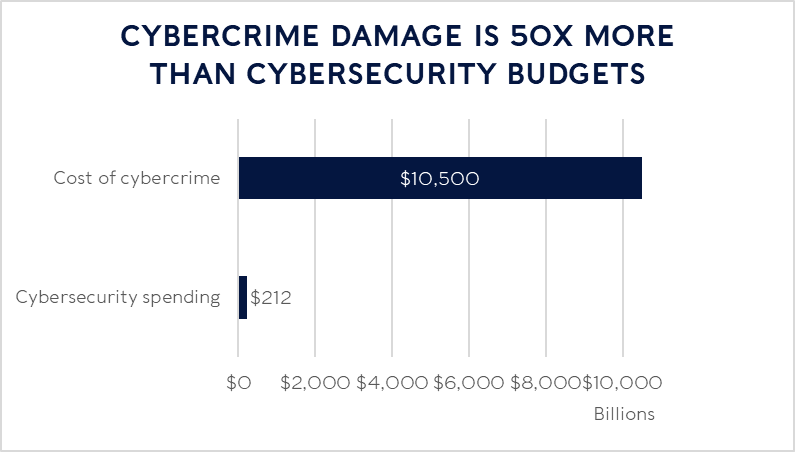
For Thomson, this structural increase in spending underlines why cybersecurity is becoming a non-discretionary priority for businesses.
“Cybersecurity is the bill companies cannot afford to stop paying,” Thomson said. “When the burglars get cleverer, you do not cancel the alarm — you upgrade it. AI is making attacks faster and more sophisticated, increasing the need for scalable protection.”
Thomson says one of the strongest drivers for CrowdStrike is the move by large companies away from fragmented cybersecurity stacks. CrowdStrike’s cloud-native platform uses a single software agent across devices, servers and workloads, which he believes makes it simpler for customers to deploy, update and expand.
He said: “Companies are drowning in security tools. CrowdStrike’s single-agent approach gives customers a simpler way to protect the devices employees use every day, and that simplicity matters when the threat environment is becoming more complex.
CrowdStrike’s growth is also supported by selling additional modules to existing customers. Thomson says roughly 80% of new business is generated from current clients buying more services, while its Falcon Flex model allows customers to use credits across the modules they need.
By the end of its last financial year, CrowdStrike had passed $5.25 billion in annual recurring revenue, up 24%, with Falcon Flex reaching $1.7 billion and growing by more than 120%.
Thomson says investors should remain aware of the risks: CrowdStrike is no longer cheap after its recovery, competition remains intense, and operational mistakes can be highly visible given the company’s global reach.
“Great businesses rarely go on sale, and when they do it is usually because the market has confused a temporary setback with a permanent problem. CrowdStrike is the sort of compounder we want to own for the long term,” Thomson concluded.