

The US’ complaint about VAT rebates for exporters adds another wild card to how tariff threats could evolve. The Trump administration appears particularly focused on the EU, but there is a risk that this could be used to threaten other major trading partners too.
Robert Gilhooly, Senior Emerging Markets Economist, at abrdn commented;
“Yesterday President Donald Trump announced he had signed a memo directing Commerce Secretary Howard Lutnick to review all non-reciprocal tariffs and non-tariff barriers against the US and recommend remedies.
Lutnick has said that all investigations will conclude by 1 April, with remedies (almost certainly additional tariffs) being announced as early as 2 April.
Trump said that recent product-specific tariffs, such as those on steel and aluminium announced earlier in the week, would apply “over and above” reciprocal tariffs. He also reaffirmed that tariffs on cars, semiconductors and pharmaceuticals will be announced in due course.
The definition of “trade barriers” cited in the memo is extremely broad. Non-reciprocal tariffs, taxes, VAT rebates for exporters, subsidies, regulatory barriers, currency manipulation and suppression of wages are all named points of inquiry.
A factsheet issued alongside the memo highlighted trade practices by the EU, India, Brazil, China, France and Canada as being of particular concern, while Trump also mentioned Japan and South Korea during his press conference.
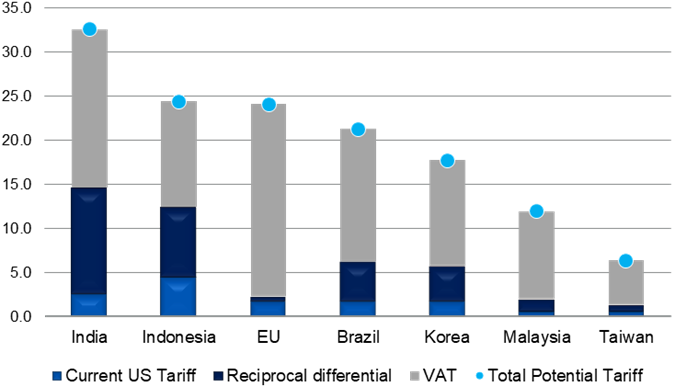
Given typically higher tariff rates, large emerging markets (EMs) such as India, Indonesia and Brazil are vulnerable to an equalisation of product-level tariffs via reciprocity. And domestic interest groups in these countries may make it difficult to just lower their own tariffs to avoid US reciprocal rates. For example, agricultural interests in India would likely make it difficult for the country’s Prime Minister Narendra Modi to offer material tariff adjustments to Trump on this front.
The US’ complaint about VAT rebates for exporters adds another wild card to how tariff threats could evolve. The Trump administration appears particularly focussed on the EU, but there is a risk that this could be used to threaten other major trading partners too (see Figure 1).
Figure 1: Reciprocal tariffs are a risk for several major EMs, while additional tariffs related to VAT rebates for exporters risk driving tariffs sharply higher
Source: WTO, US Census Bureau, PWC, abrdn, February 2025. Note: Current and reciprocal tariff rates are based on trade-weighted MFN rates. VAT rates are estimated based on general domestic rates.
The Commerce Department will propose remedies by 1 April, and tariffs motivated by VAT may not simply be set equal to other countries’ tax rates.
More generally, estimating non-tariff barriers is an imprecise art. A 2009 study across 90 countries concluded that non-tariff barriers could be equivalent to a 12% ad valorem tax, but non-tariff barrier estimates on individual products can be an order of magnitude higher.
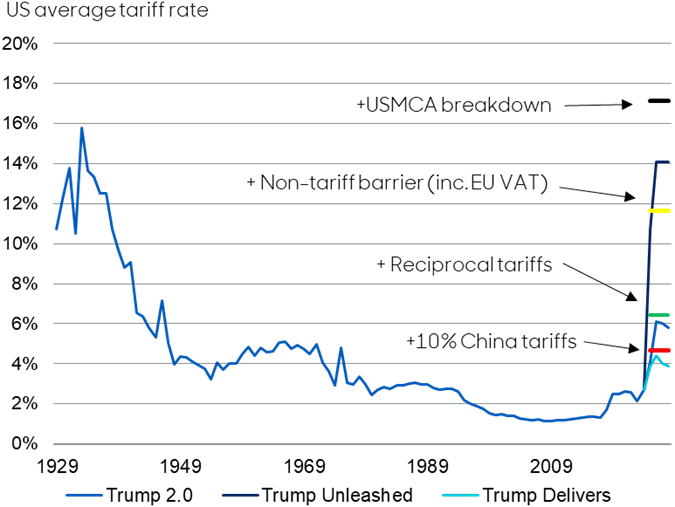
Reciprocal tariffs alone could push the average US tariff rate where we think US tariffs will head to in the end (‘Trump 2.0’). Even toned-down tariff increases in other areas, such as with VAT only impacting the EU, and non-tariff barriers primarily hitting China, could push the average US tariff rate to levels not seen since the 1930’s, which we would consider consistent with a ‘Trump unleashed’ scenario which embodies maximalist positions aiming to re-wire the global trading system (see Figure 2).”
Figure 2: The latest announcements could push US tariffs sharply higher
Source: WTO, US Census Bureau, PWC, abrdn, February 2025. Note: Current and reciprocal tariff rates are based on trade-weighted MFN rates. VAT rates are estimated based on general domestic rates.



