
Bitcoin faced geopolitical shock and macro uncertainty and refused to break. This resilience is becoming harder to ignore.
That is, over the past couple weeks, bitcoin has been pushed through a familiar stress test:
- Geopolitical escalation.
- Risk-off sentiment across global markets.
- Renewed macro uncertainty.
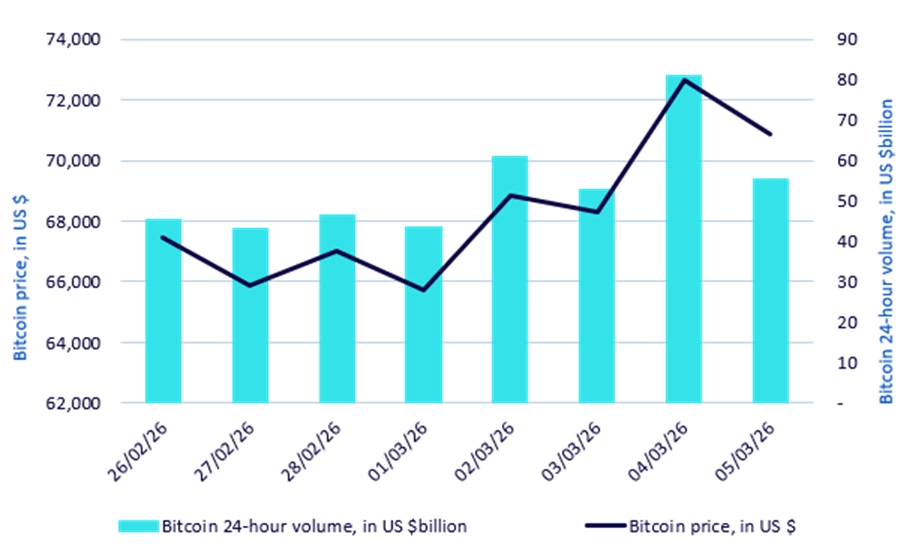
Yet the market’s response was striking. Bitcoin dipped briefly, stabilised, and then moved higher.
Figure 1: Bitcoin price and trading volume
Source: Artemis Terminal, WisdomTree. 06 March 2026. Historical performance is not an indication of future performance and any investment may go down in value.
That is not the behaviour of an asset on fragile footing. It is the behaviour of a market with real structural demand.
A geopolitical shock and a fast recovery
The trigger came as tensions in the Middle East escalated in late February. Following a coordinated US and Israel strike on Iran, risk assets broadly wobbled. Bitcoin fell ~3% and briefly found itself at $65,000 level[1].
For critics, moments like this are often presented as proof that bitcoin is simply another speculative risk asset.
But the sell-off did not stick. Within days, bitcoin had stabilised above $68,000, and by early March it was again trading in the $71,000-$73,000 range[2].
The speed of that rebound matters. Markets did not need weeks to recover. They needed days. That is, when sellers appeared, buyers were already waiting.
Institutional capital is anchoring the market
Large allocators and structural investment vehicles are no longer marginal participants. They are now a permanent part of the bitcoin ecosystem.
Unlike speculative retail flows, institutional investors tend to accumulate during volatility rather than exit it. That dynamic changes how the market behaves during stress events.
The implication is straightforward.
Bitcoin still reacts to macro shocks. No asset is immune. But the structure of the market has fundamentally shifted. Capital pools are deeper, holders are more patient, and the investor base is increasingly institutional.
That combination changes how sell-offs play out.
In earlier cycles, geopolitical shocks or macro stress could trigger prolonged drawdowns. Today the pattern increasingly looks different: sharp reactions followed by rapid absorption.
[1] Source: Artemis Terminal. 06 March 2026.
[2] Source: Artemis Terminal. 06 March 2026.