The search for yield continues
- Today’s fixed income markets are mainly driven by central bank policies, which in turn have caused negatively yielding debt to grow at a record pace. The extraordinary level of central bank stimulus has pushed interest rates lower, and as a result, the search for yield has never been stronger.
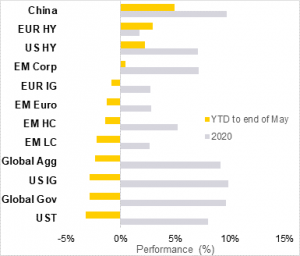
- High Yield [“HY”] continues to be in favour by investors in 2021, as it is also a lower duration asset class, relative to Investment Grade, in addition to its strong fundamentals. HY ETFs saw $2bn of inflows as at 31 May 2021, with a strong preference for USD HY exposures supported by lower EUR/USD hedging costs, along with the higher exposure to energy names.
- HY has traditionally been viewed through a lens of requiring specialist knowledge and expertise in order to ‘pick and choose’ between the best names in the sector. However, as the ongoing hunt for yield continues, HY debt may benefit from inflationary pressures as investors may prefer the shorter duration exposures that HY offers versus investment grade debt. In this space, more and more clients are using ETFs to bring diversification and flexibility to their portfolio alongside alpha and index exposures.
- Looking at the portion of the fixed income market which yields over 2.5%, more than half is made up of China bonds and investors are increasingly taking note: the 5-year China government bond yield is at 3.0% compared to the equivalent 5-year US Treasury which is yielding just 0.9%, offering a 2.1% yield pick-up. The inclusion of onshore bonds into global indices provides a structural tailwind and low correlation with other major markets is attracting investors looking to build resilience against market volatility.
- Against this backdrop China on shore bond ETFs gathered more than $4bn inflows as at 31 May 2021, mainly used for strategic asset allocation purposes from a diverse set of investors across asset owners, asset managers and wealth as well as from multiple regions.
Fig 2: Comparing returns across asset classes