The US Consumer Price Index (CPI) came in mostly in line with expectations on Thursday. The data showed headline inflation rose 2.9% in the year to August, an increase from 2.7% in the previous month but in line with expectations.
However, the monthly reading saw a larger-than-expected increase to 0.4% from 0.2% in July, versus 0.3% expected. Meanwhile, core CPI came in line with expectations at 0.3% MoM and 3.1% YoY, both unchanged from the previous month’s reading.
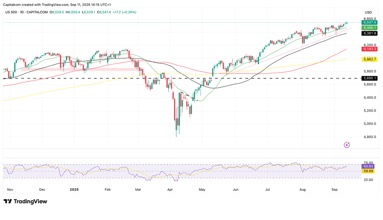
The breakdown suggests that the components excluded from the core reading are behind the price increases last month, primarily food expenses. Grocery bills are said to have seen the worst jump since 2022, a key concern for households, even if the Fed focuses more on the less volatile core reading. However, even if small pockets of price pressure remain, it is highly unlikely that this will skew the central bank from cutting rates next week. In fact, data from the CME FedWatch suggests that the odds of a rate cut remain unchanged even after the slightly higher CPI reading, with a 10% chance of an outsized 50bps cut still priced in. This highlights the fact that markets are overwhelmingly bullish on the fact that the Fed is going to cut aggressively in the next few months, as they focus mostly on the fact that the labour market has shown clear signs of softening. As a result, US equities continue to move higher despite the muddied economic outlook.
S&P 500 daily chart
Past performance is not a reliable indicator of future results.
Elsewhere, the ECB left rates unchanged at their meeting on Thursday as widely expected, keeping the deposit rate at 2.00% for the second consecutive meeting, and reiterating a data-dependent, meeting-by-meeting approach without new forward guidance. Updated staff projections pointed to a slightly stronger 2025 growth outlook while medium-term inflation is still seen near target, reinforcing the case for a cautious pause. Lagarde’s tone in the press conference was deliberately non-committal—emphasizing resilience but flagging risks from U.S. tariff uncertainty and France’s fiscal strains—and she kept the door open to future moves if the outlook weakens. Context-wise, euro-area inflation came in at 2.1% YoY in August and Q2 GDP rose 0.1%, leaving no sense of urgency to ease again in the near future.
By Daniela Sabin Hathorn, Senior Market Analyst at Capital.com