
WDFM: Does ESG matter in Fixed Income?
HL: That’s such a great question. I’d say that investors are increasingly thinking about sustainable investing and about ESG but probably that thought starts on the equity side first.
When you start thinking about a portfolio, many investors and their advisers will blend a portfolio
of both equities and bonds. If you’re going to take a sustainable view on investing as well as an ESG view, then it’s actually quite important to look across your entire portfolio because otherwise you’d have some contradiction in there. You take a view on equities, but you don’t take that view on fixed income.
So if we consider why investors are thinking about ESG, sometimes it’s regulatory driven, sometimes a client might want to prioritise environmental, social or even governance factors.
But what’s more important is taking into consideration the global position, and we are encouraged to think about these measures as there are regulations pushing us towards that. We also have to recognise that the future allocation of capital is likely to be prioritised in and into those areas.
So the questions for investors would then be, do you want to be missing out on that? In terms of bond investing, having the focus – alongside your equities – to say this is a paradigm shift and we should probably align and position our portfolio in the same way. I think this is actually a very important consideration for all investors and their advisers.
That’s why for us, we very much feel that going forward, ESG will be completely integrated into all investments. We’re currently going through a process where some investors are perhaps more advanced in that approach than others.
If we’d had this conversation two or three years ago, I think there would be much less discussion around ESG or sustainable investing. Whereas in most conversations we have with clients today this topic is raised and if not actively seeking it, clients are looking to transition their portfolios that way and need guidance and explanations around the potential impact.
It’s a really exciting place to be at the moment because of that transition, because of the viewpoint and the perspective that investors are taking.
WDFM: When it comes to so called ‘Green Bonds’, are they really green? Do you think they’re just a fad?
HL: Whether it’s driven by governments or the social, environmental side of it, there are indeed more green bonds that are being issued.
It’s very important to do our due diligence as to who’s issuing that green bond and what they’re issuing for.
For investors to walk into this with limited knowledge, they may end up with the vast majority still towards green projects. I think that’s probably where you’ve got to take a view. Do you want to invest and research every single issue or actually work with partners who have the necessary experience or work with certain within industry standards, such as the Climate Bonds Initiative that really starts to certify and classify some of these green bonds? That’s certainly the approach that we’ve taken when it comes to green bond investing. We prioritise the investments towards ones which have actually gone through the certification process from the Climate Bonds Initiative.
So, when you ask whether these investments are actually moving towards green projects, having a certification process and prioritising those issues is definitely a step in that direction.
WDFM: What do investors need to know about China bonds?
HL: Chinese bonds have got a lot of focus over the last year or two. That’s because if you look at traditional benchmarks, they previously sat outside of the emerging markets framework, or at least certainly the major ones that most investors focused on.
The Chinese bonds are now starting to be added into that emerging markets standard portfolio. What that means is that there’s increased interest in having that allocation to China when you’re looking at emerging market bonds.
The other observation around Chinese bonds is that for a lot of people, if you were to try to buy that bond directly, it’s not that straightforward. You need to have local sub- custody accounts to manage to hold Chinese bonds and also management of the local currency aspect as some of it is restricted. Putting it together into a fund, a liquid investment, like an ETF, means that any problems are taken care of by investment or asset managers like us. We deal with the custody accounts, with the currency element etc. So if as an investor you have GBP or US dollars, all you have to do is invest in that currency and we will take care of the exposure to the Chinese markets.
When you look at the yield profile, but also the return from the Chinese markets, you can see that that’s where the interesting element comes as it relates to bringing diversification and yield into a bond portfolio. I think that’s why we’re seeing that growing interest in adding Chinese bonds into the market.
I suppose just taking even a further step back from a macro lens, we all see that actually the Chinese economy continues to grow as it has been over the last 10 years. And there are many people who will continue to believe and focus on the fact that that economy will only get bigger over time. So it’s really about positioning your global portfolio to increase your exposure towards the global economy, and China is very much a part of that.
About Howie Li – Head of ETFs
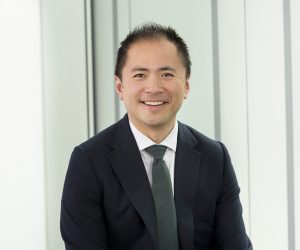 Howie leads the development and growth of the ETF business. Howie joined the investment manager from ETF Securities after the successful acquisition of the Canvas ETF business which completed in March 2018. During his time at ETF Securities for almost 10 years, Howie was most recently the CEO of Canvas after holding other positions including
Head of Legal and Co-Head of Canvas. Prior to that, Howie trained and worked at Simmons & Simmons in London advising the hedge fund industry. Howie holds a LLB from the University of Leeds and is a qualified solicitor in England and Wales.

For more information on LGIM ETFs and their fixed income range, click here.



