What’s behind solar energy’s appeal?
There are several factors driving solar’s increasing popularity.
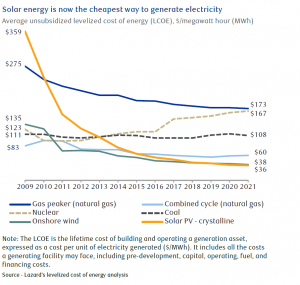
- Cheap solution: At the end of 2020, solar was the cheapest of all energy sources, taking into consideration all the costs of constructing, operating, and maintaining a solar facility over its lifetime, or the levelized cost of energy (LCOE), according to calculations by Lazard, an advisory firm. From mid-2021, rising commodity prices increased the LCOE of both wind and solar, though more slowly than for other energy sources.
- Diversify a country’s energy sources: The current energy crisis in Europe has reinforced the need for countries to diversify their energy portfolios so as not to be overly dependent on one source nor on unreliable suppliers. While the immediate response to low natural gas supplies has often been more drilling, plans to roll out new solar capacity have been accelerating in many countries in Europe, as well as other regions.
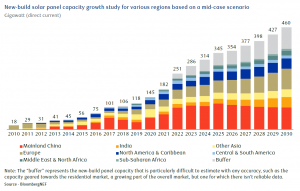
- For instance, Germany’s official target is now to reach 215 GW of solar capacity by 2030, up from its current 63 GW of installed capacity. This suggests a very rapid acceleration of deployment over the rest of the decade. Germany has already experienced strong demand for solar panels from residential and small commercial customers due to rising power prices and voluntary actions to reduce demand for Russian gas.
In Italy, 823 MW of solar capacity were installed during the first five months of 2022, an amount close to the capacity installed in all of 2021. Italy’s transmission system operator Terna suggests that 40 percent of the new installed capacity was for the residential segment.
- Help countries reach net-zero targets: Solar panels produce electricity without creating CO2 emissions. Admittedly, the manufacturing of panels consumes a great deal of energy and creates emissions, but over their 30-year lifespan, solar panels are an attractive way to help countries realize net-zero targets.
The Inflation Reduction Act in the U.S. extended the tax credit for solar by 10 years and introduced new production-based tax credits for solar manufacturing. These are likely to be a boon to an industry that suffered from tariff-related disruption for years. On June 6, 2022, the White House postponed possible duties on silicon solar module imports from Southeast Asia for two years, which should encourage additional solar installations.
Meanwhile, China’s 14th Five-Year Plan, issued in June 2022, targets to double the capacity of wind and solar over 2021–2025 from that of 2016–2020.
- Benefits from government incentives: In the U.S., the Inflation Reduction Act offers many incentives that should make the clean energy transition more affordable, including tax credits for electric vehicles, home electrification upgrades, heat pumps, and solar systems. In particular, the legislation extends a 30 percent tax credit for residential solar systems that was due to end in December 2022, to January 1, 2034. Leased or purchased battery storage systems also qualify for a 30 percent credit.
Bloomberg points out that in concert, the incentives are mutually reinforcing. Electrifying a home with solar energy that is also used to charge an EV cuts fossil fuel costs and greenhouse gas emissions. Battery systems enable homeowners to store excess solar energy generated during the day and tap it at night, thus avoiding high electric utility rates. Batteries can also help keep the lights and internet on during climate-driven blackouts, an increasingly common occurrence.
Canada also offers incentives, as does Australia. Europe has long been offering support for emissions-reducing initiatives, providing incentives that aim to make clean energy the most efficient and cost-effective option for households. Most European countries that subsidize residential rooftop solar panels pay homeowners a premium on the electricity their systems supply to the power grid. Some countries also offer subsidies to install solar panels, including France, Germany, and Italy.
For households, once the investment in a solar system is recouped, the electricity it generates is essentially free, except for maintenance costs and the service fees a utility charges to connect to the grid.