

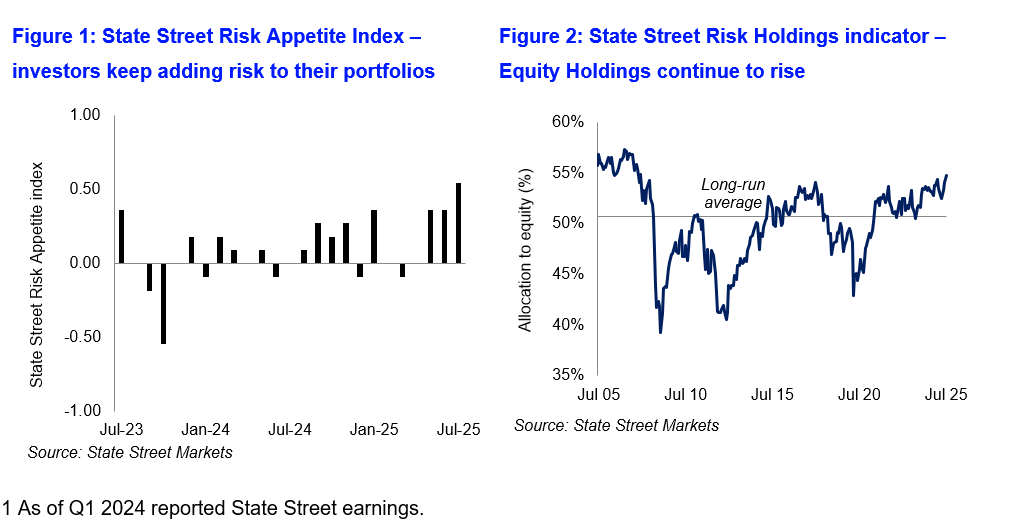
Institutional investors’ appetite for risk broadened further in July. The State Street Risk Appetite Index rose to +0.54 at the end of July, marking the highest reading since November 2020, the month COVID vaccines were discovered. Reflecting this broad risk-seeking trend, institutional investors increased their allocation to stocks by 0.7%, reaching 54.8%. This is the most optimistic stock holding since November 2007.
Despite numerous potential pitfalls for financial markets in Q3, institutional investors remain optimistic. Their aggressive buying of risky assets mirrors the fervor seen in November 2020, when COVID vaccines were announced. This suggests that investors believe the peak of uncertainty, whether geopolitical or policy-related, has passed. However, the stark contrast between their confidence and the ongoing decline in business confidence, especially in the US, is concerning. Our data shows that equity allocations are near their highest levels in 25 years. The only times they were higher were during the dot-com bubble and the GFC, serving as a caution that today’s buoyant sentiment could be vulnerable to shocks.
Beneath this overall optimism, there are intriguing nuances. Investors continue to favor US consumer discretionary stocks, hinting at potential disruptions to their growth outlook. Robust cross-border flows in July were concentrated in Japan, China, and Brazil, indicating a shift towards global growth rebalancing. In contrast, weak demand for Indian equities reflects lingering tariff and policy uncertainties. Fiscal concerns persist, with foreign demand for Treasuries, Gilts, and OATs remaining weak. Notably, after five months of persistent hedging, sentiment towards the USD stabilized in July, suggesting that investors believe policy uncertainties have peaked for now. numerous potential pitfalls for financial markets in Q3, institutional investors remain optimistic. Their aggressive buying of risky assets mirrors the fervor seen in November 2020, when COVID vaccines were announced. This suggests that investors believe the peak of uncertainty, whether geopolitical or policy-related, has passed. However, the stark contrast between their confidence and the ongoing decline in business confidence, especially in the US, is concerning. Our data shows that equity allocations are near their highest levels in 25 years. The only times they were higher were during the dot-com bubble and the GFC, serving as a caution that today’s buoyant sentiment could be vulnerable to shocks.
About the indicators
The Institutional Investor Indicators (the three i’s) were developed at State Street Associates, State Street Global Markets research and advisory services business. They measure investor confidence or risk appetite quantitatively by analyzing the actual buying and selling patterns of institutional investors derived from State Street’s USD 44trn1 in assets under custody and administration ((note: not investors’ balances held at State Street itself)). The Risk Appetite Index is derived from measuring investor flows in twenty-two different dimensions of risk across equities, FX, fixed income, commodity-linked assets, and asset allocation trends. The index captures the proportion of the twenty-two risk elements that saw either risk seeking or risk reducing behavior. A positive reading suggests that on balance investors are adding to their risk exposures, while a negative reading suggests risk reduction. State Street’s Holdings Indicators capture the share of investor portfolios allocated toward equity, fixed income and cash going back to 1998.
Comment provided by Michael Metcalfe, Head of Macro Research, State Street Markets



