A lengthy recovery process
Starting in 2017, all uranium mines began to reduce their supply because At $ 18/lb, the vast majority of uranium mines was unprofitable. Cameco and Kazatomprom, the two largest producers in the world, have eliminated 17.5% of the world supply.
But these production stoppages did not have a sufficient impact on supply and prices, due to the existence of long-term supply contracts and elevated inventory levels.
In 2020, the pandemic had significant effects on production. Kazatomprom had to downsize its operations while Cameco announced the temporary suspension of the world’s largest uranium mine.
However, it was not the closure of some mining facilities that triggered the start of a bull market for uranium-related equities. Rather, it is the massive inflows into the mining stocks from institutional investors in anticipation of a pick-up in demand for physical uranium. These flows triggered an acceleration in the bull market from the end of 2020.
A Trust changed the uranium market
In April 2021, Sprott, a Canada-based global investment manager took over Uranium Participation Corp (UPC) and renamed it Sprott Physical Uranium Trust.
While the previous Trust held a static amount of uranium, the new vehicle takes a very different approach. A mechanism allows Sprott to issue new units each time the Trust trades at a premium to its net asset value. This extra cash can then be used to buy more uranium. This mechanism has created a virtuous circle: investors who hold uranium buy the trust, pushing the premium over the NAV up, forcing the trust to buy even more uranium, driving up prices and attracting more. investors to buy the Trust. And so on.
At the end of May, UPC held around 19 million pounds of uranium. Three months after the official launch of the new Trust, that quantity held expanded to over 31 million pounds. As highlighted by Patrick Poke (Livewire Australia), that additional quantity is over 8% of global annual mine supply. “If the current pace were to continue for a year, the Trust would end up buying one third of the world’s mine supply”, he added.
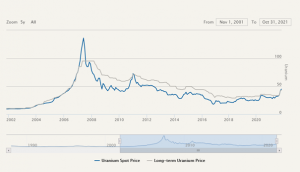
At the same time, uranium development companies are raising capital to buy uranium for storage. This has the consequence of drastically reducing the available inventories, with meaningful effects on the price of uranium. While the price was around $ 28 at the end of March, the price exceeded $ 50 in September, a dramatic increase although the price remains below the level from which mines can afford to increase production (60- 70 dollars). As a result, the market remains under-supplied by 50 million per year as the Trust and nuclear power stations search for inventory.
Uranium spot price and long-term price – source: Cameco