

Managed Portfolio Services (MPS) have become a cornerstone of financial advice in the UK, offering advisers a streamlined way to deliver diversified investment solutions to clients. These portfolios cater to a wide range of risk profiles and investment goals, making them a popular choice in an increasingly competitive market.
Morningstar’s UK Managed Portfolio database, launched in 2022, contains over 1400 portfolios from around 70 providers. It holds data including costs, independently calculated performance, and complete underlying holdings. Providers assign each portfolio an investment style description of active, blended, or passive – referring to the primary type of underlying holdings used. Many providers have a choice of offerings in each camp.
The data reveals clear trends in the UK on-platform MPS space, including a slump in new product launches, declining fees and costs, and the growing use of passive funds to build portfolios.
While the earliest portfolios in the database date back to 2004, the market saw explosive growth between 2018-2022, when over half of today’s portfolios were incepted. New launches have since slowed dramatically, likely reflecting a saturated market with ample choice, rather than a lack of demand for MPS solutions overall.
Passive holdings more prevalent
The shift to passive and blended strategies is unmistakable. In 2022, 61% of portfolios were labeled “active”, but that figure had dropped to 45% by July 2025. When we examine the actual use of index funds, using a look-through analysis, the number of truly active portfolios appears lower still.
Our analysis shows a steady decline in the launch of active offerings, the rise of passive offerings, and the strong emergence of blended approaches that combine meaningful amounts of both active and passive holdings.
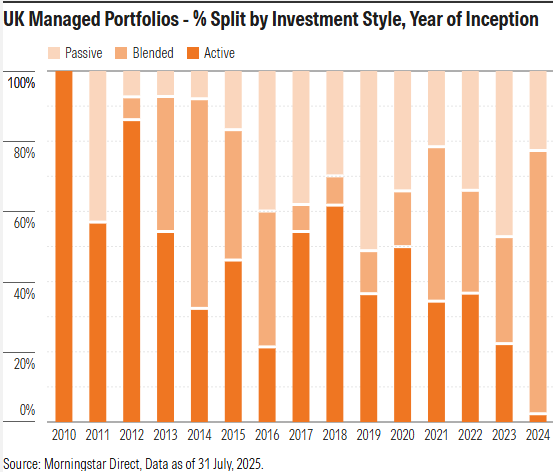
Source: Morningstar Direct, Data as of 31 July 2025.
Focus on cost
Why has the active approach taken a back seat to newer passive and blended solutions? While cost is not the sole consideration for advisers, it’s still a key battleground in a relatively crowded marketplace, and passive content enables big reductions in the overall cost, when underlying fund charges are taken into account. While the median management fee for active and blended managed portfolios is similar at 0.24%, active portfolios incur significantly higher underlying fund costs at a further 0.58%, compared to an additional 0.36% for the median blended option.
Source: Morningstar Direct, Data as of 31 July 2025.
Between 2022 and 2024, overall costs – management fee, plus underlying holding costs – trended lower, mainly due to a reduction in underlying holding costs.
Passive funds dominate the list of most frequently held underlying funds. Broad equity and bond market index funds are in especially wide use. They offer efficient, low-cost market exposure, making them suitable core building blocks for many types of managed portfolios.
Beyond core building blocks
Mutual funds remain the go-to vehicle for passive exposure due to the added operational friction associated with ETFs in a managed portfolio context. But as ETFs are well-suited to more innovative strategies, they can provide niche exposures not found in index funds. The most widely-held ETFs in UK managed portfolios tend to be those with socially responsible investment or environmental, social, and governance investment policies. Around 25% of portfolios in the database are described by their providers as sustainable, and on average they are more likely to also be labelled active.
Compared to multi-asset funds, we find that UK managed portfolios make less use of alternatives and stick more to equities, bonds and cash. Cost is one reason, since alternatives funds typically incur higher management charges, along with transparency and the need for underlying funds to have broad platform availability. Where alternatives funds are held, multi-strategy and macro trading categories are the most popular.
Looking Ahead
As the MPS market evolves, the choice of underlying funds will remain central, and cost efficiency is likely to remain a key consideration, but there remains a place in portfolios for active strategies, particularly where they are seen to offer more differentiation.
Author Bio
Tom Mills is Principal, Multi-Asset Strategies for Morningstar, a wholly owned subsidiary of Morningstar, Inc. He leads Manager Research multi-asset fund research and ratings in the UK and cross-border markets.
Before joining Morningstar in 2022, Mills worked for Hargreaves Lansdown as a senior member of the fund research team. Prior to that, he was based in Australia where he spent 12 years carrying out fund research at BT Financial Group, and Standard & Poor’s.Mills holds a bachelor’s degree in Politics & International Relations from the University of Reading. He also holds the Chartered Alternative Investment Analyst designation
This feature was part of our MPS Insights 2025 publication – designed with advisers’ needs in mind. You can download your copy of the publication here….https://wealthdfm.com/2025-26-managed-portfolio-services-mps-insights/