
Valuations at 10-year lows
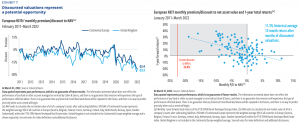
Real estate securities in Continental Europe and the U.K. have continued to trade at relatively attractive discounts to their net asset values (NAVs). With a discount to net asset value (as of March 31, 2022) of 22.4% and 23.3% for Continental Europe and the U.K., respectively, real estate securities are trading near the lowest levels in a decade. Discounted valuations have historically been a buying opportunity for European REITs (Exhibit 7).
Conclusion
Defensive posture with upside potential
In today’s environment—marked by rising inflation, slowing economic growth (with the potential for recession) and heightened geopolitical risk—we believe European real estate securities offer defensive growth opportunities.
Logistics, towers, health care and self storage are among defensive sectors that also have structural growth characteristics. Examples of potentially recession proof sectors (due to long-term contracts, among other factors) include health care, retail, senior housing and German residential. We also believe student housing is potentially “recession proof” despite the use of short-term contracts, mainly because the sector is extremely undersupplied, as is most rental housing across Europe.
We believe that specialist managers with the resources and experience to understand the market—economic factors, country dynamics and sector characteristics—can most effectively position and, if and when deemed necessary, shift portfolios appropriately and potentially enhance risk-adjusted returns.
Listed real estate as a value and growth complement to core private
In addition to a still-healthy economic backdrop, inflation-hedging characteristics, strong income and growth prospects, and attractive valuations, listed real estate may be supported by activity in the private market, where several buyouts of listed companies have occurred in sectors such as office, logistics and residential. These deals suggest that investors continue to see value across the real estate market in Europe.
Listed real estate can also serve as an effective foundation for a comprehensive real estate strategy, complementing direct investments and targeted opportunistic or value-add private real estate funds, in our opinion.
One reason is performance. Over the past 10 years, European listed real estate has outperformed core open-end private real estate funds by 420 basis points annually (Exhibit 8). REITs have achieved this return premium while providing daily liquidity and generally employing relatively low-risk core real estate investment strategies, with a focus on high-quality, stabilized assets. REITs also typically employ modest leverage of 30–40%, in line with many core private real estate funds.

Diversification through listed and private allocations
We believe both listed and private real estate may deserve a place in a strategic asset allocation. The precise mix between listed and private will be driven by investor-specific factors, including (but not limited to) the need for liquidity, preference for income versus total return, general risk tolerance, aversion to mark-to-market volatility and fee sensitivity.
Overall, we believe European listed real estate is poised to play a potentially meaningful role in defending against inflation, while offering solid relative yield and secure income potential—even if recession hits Europe and long-term interest rates start to peak.



