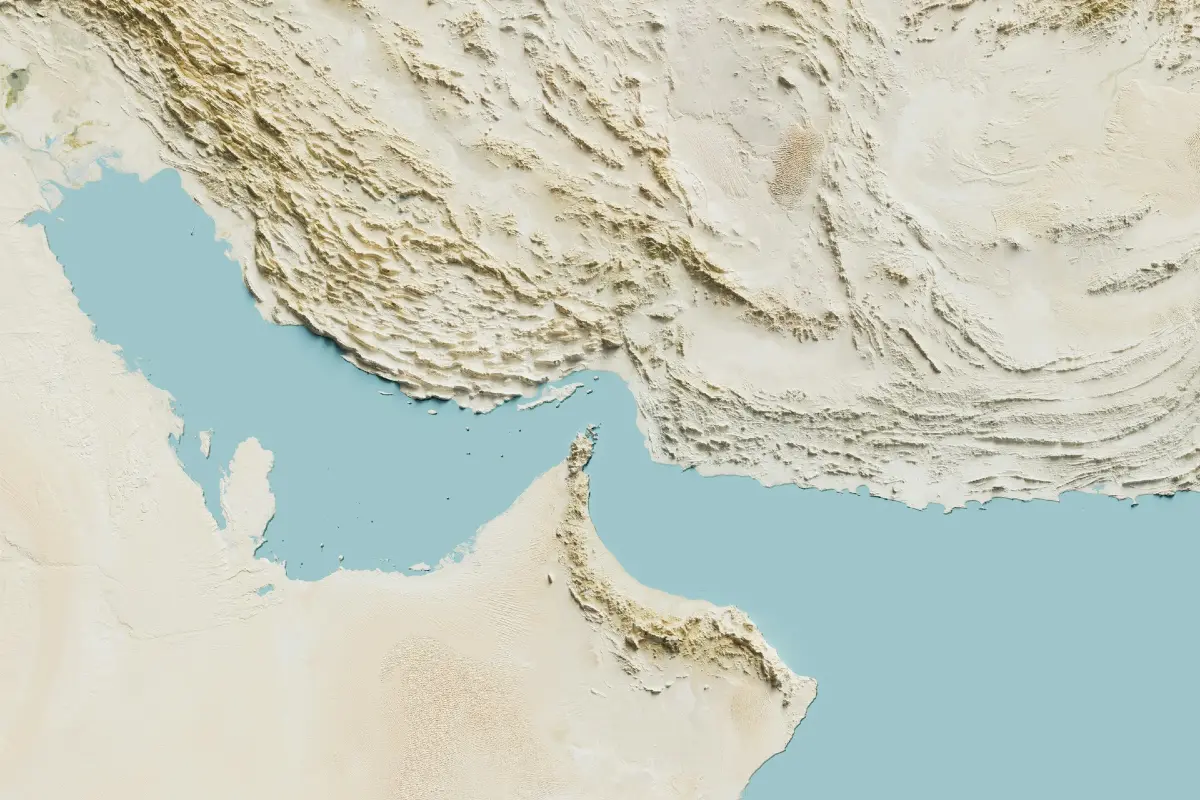
When the Strait of Hormuz is at the frontline of geopolitical tension, Asia feels it first. The US–Iran conflict has disrupted commercial traffic through Hormuz, sending oil and liquefied natural gas (LNG) prices sharply higher, and forcing governments and corporates across Asia to confront a blunt reality: energy security is still largely imported, and therefore still hostage to geopolitics.
Hormuz is not just another chokepoint. According to International Energy Agency[1] (IEA), in 2025 the strait carried about 20 million barrels per day of crude and products, around a quarter of seaborne oil trade, and almost 80% of those flows head to Asia; it also carries LNG exports from Qatar and the UAE that represent nearly 19% of global LNG trade, with Asian buyers taking the bulk.
David Smith, Senior Investment Director of Asian Equities, Aberdeen Investments, commented: “This shock doesn’t so much create Asia’s clean-energy transition as reinforce the rationale for it, and may further accelerate its pace. Asia was already building solar, wind and storage at scale for cost and climate reasons. What Hormuz does is reinforce urgency, turning renewables from a decarbonisation priority into a strategic hedge.”
Who benefits and where capital is actually going
The clearest beneficiaries of this shift are not those operating at the edges of the energy system, but those at its centre: equipment manufacturers, grid operators, battery suppliers and power‑management specialists.
David Smith said: “Asia is where much of the world’s clean‑energy hardware is designed, manufactured and scaled, and that industrial depth is difficult to replicate elsewhere. Economies that combine manufacturing strength with large‑scale domestic deployment are especially well positioned to capture both economic growth and strategic relevance as the transition accelerates.”
At a time when renewables now account for roughly one‑third of China’s electricity generation, the renewed focus on energy security further enhances the appeal of Chinese renewable and energy‑storage champions (Source: IRENA, 2026. Renewable Capacity Statistics 2026 and Renewable Energy Statistics 2025).
David Smith said: “At the country level, China’s clean‑tech dominance provides strategic flexibility rather than a simple geopolitical offset. Leadership in batteries, solar panels and electric vehicles reduces long‑term dependence on imported hydrocarbons while reinforcing export channels that support employment, growth and technological leadership. Importantly, scale also drives down system costs, reinforcing energy affordability at home.”
For example, CATL, a global leader in energy storage, posted strong profit growth last year alongside sequential margin recovery and sustained leadership in EV batteries and energy storage. This reinforced confidence that scale and cost control can offset lithium price volatility. This stock-specific momentum, combined with CATL’s positioning within AI‑ and storage‑adjacent infrastructure, allowed it to continue outperforming even as risk aversion rose.
Yadea, a Chinese manufacturer of electric two-wheelers, similarly benefited from an earnings inflection, with FY25 results showing a sharp rebound in profitability well ahead of expectations. The market interpreted this as evidence that overseas markets, particularly Southeast Asia, are emerging as a credible second growth engine, driving a rapid reset in sentiment.
David Smith continued: “South Korean companies are also at the forefront of battery technology, occupying critical positions across global EV and energy‑storage supply chains, reflecting deep capabilities in high‑performance chemistries, manufacturing scale, and continuous innovation.”
“Besides, Southeast Asia is emerging as a growing force in clean‑energy supply chains. In recent years, Vietnam, Thailand and Malaysia have ranked just behind China as global leaders in solar PV manufacturing. Indonesia, the largest energy consumer in ASEAN, holds substantial potential in geothermal energy and is accelerating development in large‑scale solar and hydropower, including some of the world’s largest floating solar projects.”
“That said, investment opportunities are not uniform, and long‑term institutional capital is not chasing every “green” theme indiscriminately.”
What long term investors are actually prioritising
Investors are operating in what’s been called the ‘messy middle’ of the energy transition, where decarbonisation ambitions collide with geopolitical shocks, energy security concerns, grid transition realities, and uneven policy execution. This requires disciplined capital allocation across technologies and systems that sustain reliability today while enabling lower emissions over time. Periods like this tend to be uncomfortable, but they are also where mispricing emerges, particularly for assets and companies that help bridge the gap between legacy systems and the energy system we are trying to build.
David Smith said: “In this context, capital across Asia continues to concentrate in areas with proven economics, scale and system relevance. Utility‑scale solar, grid infrastructure and enabling technologies such as power electronics and battery storage still attract the bulk of inflows, offering relatively predictable cash flows while directly supporting energy security and affordability.”
Infrastructure remains central to Asia’s energy future. Investments in ports, LNG terminals, pipelines and transmission networks continue to underpin diversification efforts and stabilise supply during periods of volatility.
The key shift is that infrastructure is now being assessed through a transition lens, rather than as purely legacy assets. Its value increasingly lies in how effectively it supports system resilience, cleaner energy integration and long‑term affordability.
David Smith concluded: “In a world where energy transition, energy security and affordability must be delivered together, the winners will not be hardware manufacturers or asset owners in isolation. They will be platform‑style operators, integrators and system orchestrators, those capable of stitching multiple technologies together into something that actually works at scale, under real‑world conditions. The Strait of Hormuz crisis does not change Asia’s direction. It clarifies it.”