
Electricity demand, grid investment and AI-related infrastructure are expected to be key themes over the next five years, according to Will McIntosh-Whyte, Fund Manager of the Greenbank Multi-Asset Portfolios at Rathbones Asset Management.
He believes investors are increasingly focused on businesses that can reduce waste, improve productivity and deliver long-term value.
“The volume has been turned down on sustainability claims and rhetoric recently, but the underlying progress has continued. I think there has been a helpful reset: one that has created a more practical conversation, focused on what can realistically be achieved.”
“There is a solid truth at the core of sustainability: less waste is cheaper than more waste, happier workers are more productive, and cleaner production is more efficient over the long term. That is why many companies continue to invest in these areas.”
McIntosh Whyte
Electricity demand enters a new phase
McIntosh-Whyte identifies electricity as one of the most important themes for investors over the next five years. After a long period of limited generation growth in developed markets, demand is rising as economies electrify, data centre usage expands and investment in grid infrastructure accelerates.
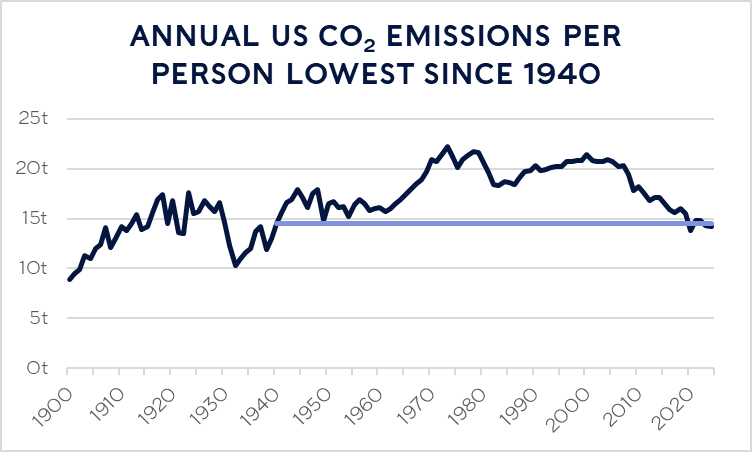
According to Enerdata, electricity generation growth across the G7 has averaged just 0.3% a year over the past quarter century. At the same time, electricity’s share of global energy use has increased from 15.5% in 2000 to around a quarter today.
“After decades of being treated as a mature, slow-growth industry, electricity is quickly becoming one of the most strategically important commodities in the world,” says McIntosh-Whyte. “The investment needed in grids and networks is finally happening, and that creates a meaningful opportunity for companies enabling more efficient, reliable and cleaner power systems.”
AI: a demand shock and an efficiency driver
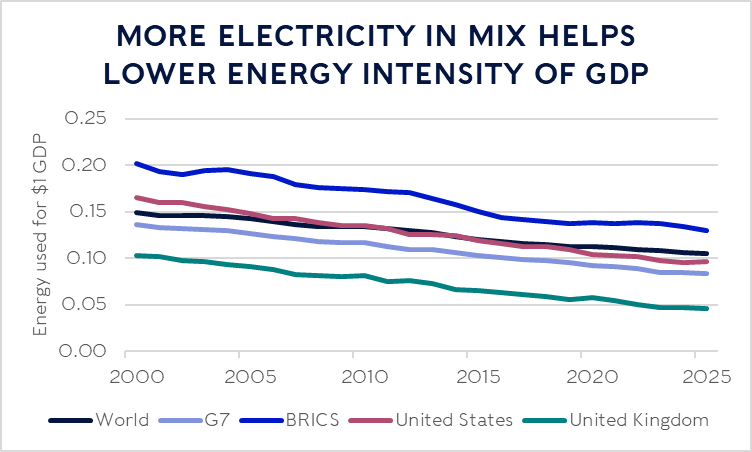
While AI has intensified concerns over energy consumption, McIntosh-Whyte argues it should also be viewed as a source of productivity gains across the wider economy.
The International Energy Agency expects total data centre electricity use to roughly double by 2030, reaching close to one trillion kilowatt-hours. Research by Schneider Electric suggests AI alone could account for up to half of all US electricity demand growth between 2025 and 2030.
McIntosh-Whyte says: “That is a significant demand shock, and it is arriving just as grids globally need substantial investment after decades of underspending. The encouraging part is that AI itself is also driving rapid efficiency gains. Power consumption per AI task is falling sharply, and similar productivity improvements are emerging across science, technology, manufacturing and clean energy generation.”
Resource security and the case for efficiency
Another major theme is the growing focus on securing reliable access to power, materials, chips and other critical inputs. McIntosh-Whyte believes this could increase demand for technologies that help businesses be more efficient.
“There is a trade-off between efficiency and resilience,” he says. “Recycling existing resources, reducing waste and doing more with less are all forms of productivity.”
McIntosh-Whyte highlights precision agriculture as an example of sustainability that can improve productivity and reduce costs. Technologies such as GPS, cloud computing, sensors and targeted application tools can help farmers monitor water use, manage nutrients more accurately and reduce chemical inputs while maintaining yields.
He says: “Deere’s See & Spray technology can cut herbicide use by up to half while maintaining yields. That means better economics for farmers and less chemical run-off into rivers. This is sustainability that pays for itself.”
Cleaning up harder-to-abate industries
McIntosh-Whyte also sees opportunities in companies developing technologies that make more carbon-intensive industries cleaner and more efficient. Better sensors, software and equipment are helping water companies identify leaks, mining businesses improve yields and industrial users reduce water and chemical consumption.
“If we can support businesses making technology that helps clean up the dirtiest industries, that represents enormous real-world progress. Many of these industries produce the raw materials that are critical to modern life, so improving their efficiency matters.”
Will McIntosh-Whyte, Fund Manager of the Greenbank Multi-Asset Portfolios at Rathbones Asset Management
Despite recent challenges for sustainable investing, McIntosh-Whyte believes the next phase will be defined less by ‘lofty aspirations’ and more by capital flowing towards electricity networks, infrastructure, resource efficiency and productivity-enhancing technologies.



