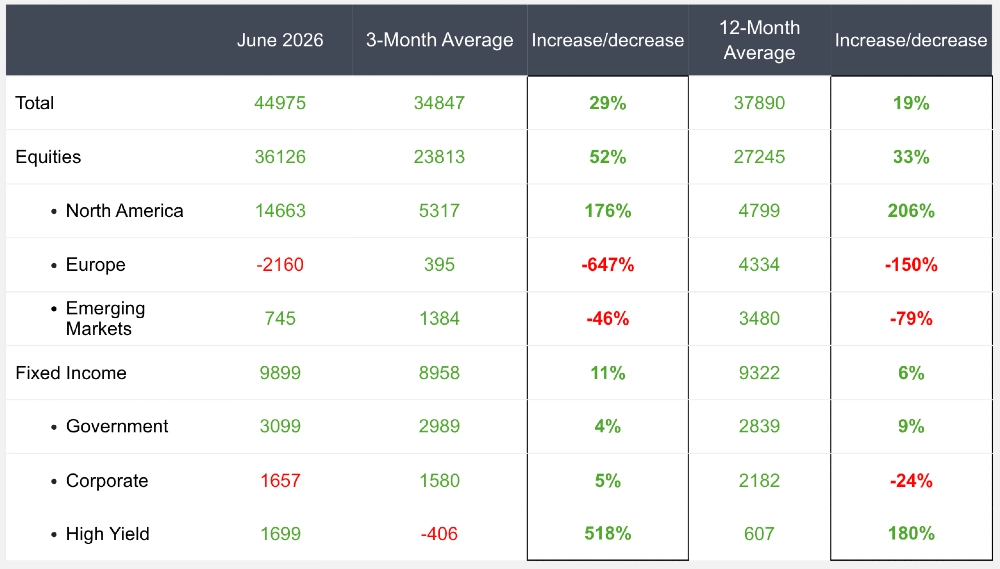
The European UCITS Exchange Traded Funds (ETF) market* remained on a growth trajectory in June. With net inflows of USD 44.9 billion, flows were above both the three-month and twelve-month averages.
Particularly noteworthy was the return of investor interest in the United States. US equity ETFs attracted USD 14.6 billion, the highest inflows of any equity region, continuing a trend that emerged throughout the second quarter.
“The story of the second quarter was the return of the United States. While investors were allocating more heavily to Europe and other regions at the start of the year, we are now seeing a clear preference for the US market again. Strong corporate earnings, combined with new record highs in equity markets, have boosted investor confidence.”
Stefan Kuhn, Head of ETF & Index Distribution, Europe at Fidelity International
The S&P 500 reached new highs during the second quarter, while robust earnings helped to ease valuation pressures. Consequently, US-focused products attracted the largest share of equity inflows in June. Meanwhile, Europe continued to lose momentum. European-focused equity ETFs recorded net outflows for the third consecutive month, reflecting persistently subdued short-term growth expectations across the region.
Net inflows/outflows UCITS ETF (US$mil)
Commodity ETFs lose appeal
Another notable trend in June was weaker demand for commodity ETFs. Outflows coincided with a decline in gold prices after geopolitical tensions in the Middle East eased somewhat compared with previous months.
“With the immediate escalation phase now behind us, some of the geopolitical risk premium has faded from commodity markets,” says Kuhn. “At the same time, many investors expect central banks to keep interest rates higher for longer, making non-yielding asset classes such as gold less attractive.”
Although oil prices have also declined in recent months, the impact of the energy crisis on inflation and monetary policy remains a key issue for capital markets.
Q2: A record quarter for active ETFs
Despite ongoing geopolitical uncertainty and fluctuating economic expectations, the second quarter of 2026 was the strongest quarter on record for ETFs. Active ETFs were a particular standout, reaching record net inflows and continuing to increase their share of the overall ETF market.
“Strong demand for active ETFs shows that investors increasingly want to differentiate between regions, sectors and individual companies. In a market where the gap between winners and losers is widening, active security selection can provide real added value.”
Stefan Kuhn