José Torres, Senior Economist at Interactive Brokers, reveals how markets are rebounding following last Friday’s turbulence as Wall Street looks to Fed rate cuts for enthusiasm ahead of critical economic data later this week.
Participants anticipate around 75 basis points of reductions this year, with this month’s meeting potentially featuring a super-sized 50, especially if Tuesday’s benchmark revisions for non-farm payrolls shave a million workers off the count. Additionally, he dives into Monday’s US Manheim used car price report and offers an international roundup.
The Potential for a Significant Payroll Adjustment Has Investors Focused on a Possible 50 From the Fed
Markets are rebounding following last Friday’s turbulence as Wall Street looks to Fed rate cuts for enthusiasm ahead of critical economic data later this week. Participants anticipate around 75 basis points of reductions this year, with this month’s meeting potentially featuring a super-sized 50, especially if Tuesday’s benchmark revisions for nonfarm payrolls shave a million workers off the count. Meanwhile, significant PPI and CPI inflation figures will be released on Wednesday and Thursday. Both publications are poised to influence the central bank’s pace down the monetary policy stairs. A heavy subtraction from the worker roster alongside a downside miss on the CPI is likely to raise the odds of a half-percent to a coin flip. The increased prospects of financial accommodation amidst expanding economic conditions have stoked bullishness among investors who are scooping up stocks in all the major benchmarks and in most of the offensive sectors. Treasuries are additionally catching bids as the yield curve descends in bull flattening fashion, led by the long end. The commodity complex is advancing ex lumber and attracting buyers. Conversely, the greenback is retreating on lighter domestic borrowing costs, and volatility protection instruments are experiencing weaker demand.
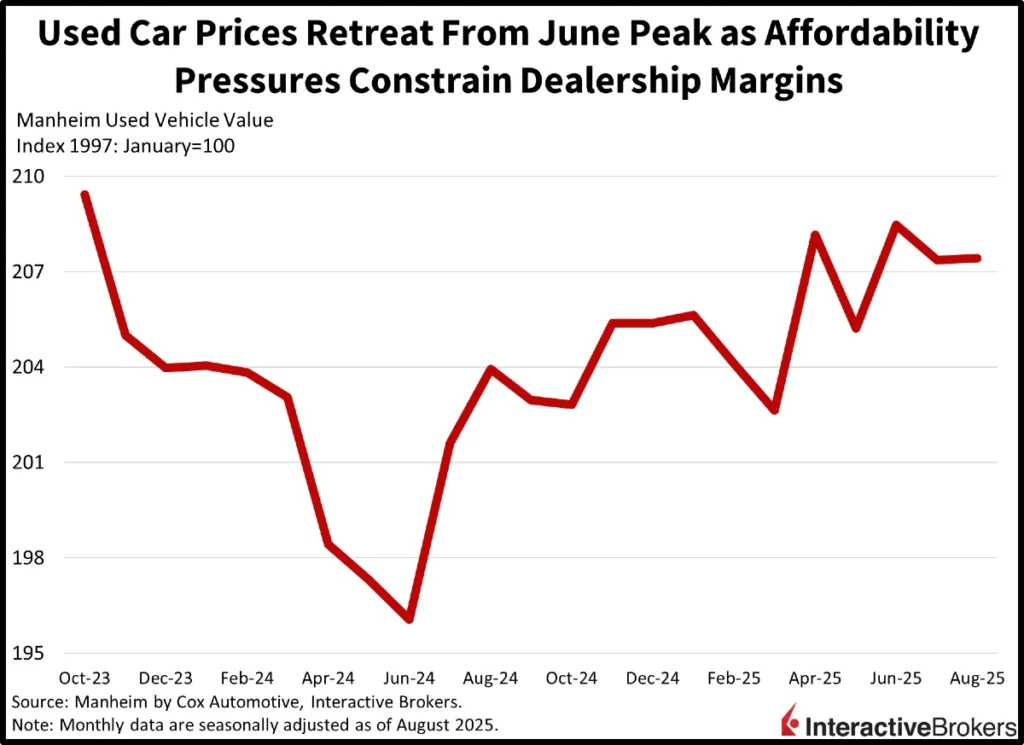
Used Vehicle Price Gains Ease
Monday morning’s economic calendar was quiet, but Treasuries and inflation expectations received an assist from decelerating automobile prices. Monday’s update to the Manheim Used-Vehicle Value Index reflected flat charges on a month-over-month (m/m) basis amidst a 1.7% year-over-year (y/y) cost increase. August’s results compare to July’s 0.5% m/m decline and 2.9% y/y climb. Across categories, EVs, luxury, and SUVs saw costs advance 4.6%, 2.3%, and 1.3% y/y, while the compact and mid-size segments experienced retreats of 3.5% and 2%. Sales were strong last month; however, affordability pressures amongst consumers, driven by elevated loan rates, constrained dealership margins.
Payroll Revision and Price Indices Will Be Critical This Week
With a pivotal week of data and a critical interest rate decision in only nine days, we are anxiously awaiting updates on employment while the Bureau of Labor Statistics and the Federal Reserve face unprecedented scrutiny. A heavy downward adjustment to total nonfarm payrolls, which is anticipated, would strengthen the argument that the central bank has been far too late in reducing its benchmark, since hiring levels have been much softer than we all expected. Meanwhile, the White House is almost certainly not going to remain quiet against such a potential backdrop and will probably raise its pressure on the monetary authority to ease financial conditions. But the Producer and Consumer Price Indices (PPI & CPI) are also going to hold weight, although job market health is currently the priority. And as we encounter a plethora of important economic data, bond vigilantes and fixed-income investors alike will have their views heard loud and clear as the Treasury gears up for offerings of 3-, 10- and 30-year notes and bonds from Tuesday to Thursday. Fed independence, deficits, inflation expectations and growth prospects will be top of mind for auction participants as we progress through a few eventful trading sessions.
International Roundup
China’s Trade Surplus Grows
China’s export growth rate in August fell more than 50% y/y, but imports also weakened, and the country’s trade surplus grew m/m. In August, the value of products shipped abroad exceeded the total price tag of items purchased from foreign providers by $103.3 billion. That was up from $98.2 billion in July, and it surpassed the economist consensus estimate of $99.4 billion. Also, last month, products sold to foreign markets were 4.4% higher than in the year-ago period, a noticeable deceleration from the 7.2% y/y growth rate in July. Economists expected a 5% jump. Meanwhile, imports grew 1.3%, considerably below the 3% estimate and July’s 4.1% rate.
Also in August, a global shift in the country’s trading continued following President Donald Trump’s efforts to accelerate the trend of onshoring manufacturing by implementing tariffs. Exports to the US sank 33% m/m while imports from the world’s largest economy contracted 16%. Conversely, the value of shipments for Southeast Asia customers and the European Union grew approximately 23% and 10%, respectively.
Economic Anxiety Weighs On European Investors
Anxieties about the overall economy caused investor sentiment among capital market participants in the eurozone to drop, with the September Sentix Investor Confidence index moving from -3.7 to -9.2, considerably worse than the -2.2 anticipated by the economist consensus.
Views for the coming months and current conditions weakened, falling from 6 and -13 to 0.8 and -18.8. The weakness was particularly acute in Germany, the eurozone’s largest economy, with a 9.4-point decline to –22.1.
Japan PM Steps Down
Japanese Prime Minister Shigeru Ishiba has resigned less than one year after accepting the leadership role. His support weakened after his party, the Liberal Democratic Party, had disappointing results in a July election after having dominated politics for many years. In resigning, Ishiba said he made the decision to avoid dividing his party. The resignation comes shortly after Japan finalized an agreement with the US that involves the western trading partner imposing a 15% import levy on the country’s products. Ishiba will remain in the position until his party selects a new leader.
Sentiment Regarding Japan’s Economy Improves
Japan’s survey of sentiment among service providers, such as barbers, restaurants, and taxi drivers, depicted improving conditions in July.
The Economy Watchers Current Index climbed from 45.2 in June to 46.7, exceeding the economist consensus estimate of 45.6. It was the highest result since the February 10 print of 48.6. In another matter, the total value of outstanding loans from Japanese banks increased 3.6% y/y in August. Economists expected the rate of increase to remain unchanged from July’s 3.2%.